Laws of Sines & Cosines
Solve oblique triangles, investigate the ambiguous case, and choose a law from the information given.
Learning goals
- Match each side to its opposite angle.
- Solve ASA, AAS, SSA, SAS, and SSS triangles.
- Recognize when SSA gives zero, one, or two triangles.
Oblique triangles and notation
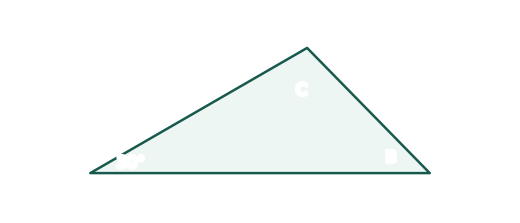
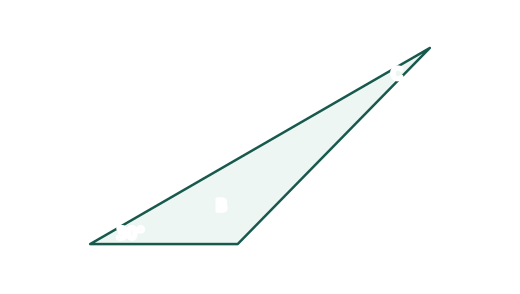
Let us label the picture before choosing a rule. Each lowercase side name belongs opposite the corresponding uppercase angle, even if the triangle is turned around. Mark what is given and what is missing. The arrangement of that information, rather than the appearance of the drawing, will decide which rule helps us first.
An oblique triangle has no right angle. Label the angles \(A,B,C\) and their opposite sides \(a,b,c\). A triangle needs at least one side and enough additional information to fix its shape and size.
| Given information | First step |
|---|---|
| ASA or AAS | Angle sum, then Law of Sines |
| SSA | Law of Sines, with an ambiguity check |
| SAS | Law of Cosines for the missing side |
| SSS | Law of Cosines for an angle |
AAA determines shape but not size. Sides must be positive and obey the strict triangle inequality.
The Law of Sines
What the proportion compares
In any nondegenerate Euclidean triangle, the ratio of a side length to the sine of its opposite angle is the same for all three sides.
It allows a complete known pair to transfer information to another pair. A drawing need not be to scale: use the labels to identify opposite pairs rather than judging their apparent positions.
Right-triangle ratios gave us a useful starting point, but an oblique triangle may have no right angle. We can still introduce an altitude and use those familiar ratios in the smaller triangles. The Law of Sines is what remains when we connect the two descriptions of that altitude.
\[\frac{a}{\sin A}=\frac{b}{\sin B}=\frac{c}{\sin C}\]Each side is paired with its opposite angle. Use a complete known pair to build a proportion. Use degree mode throughout this lesson.
Find a missing side
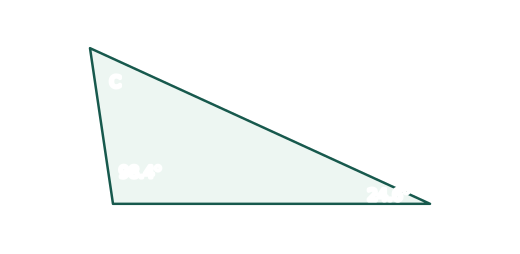
Show worked solution
AAS practice
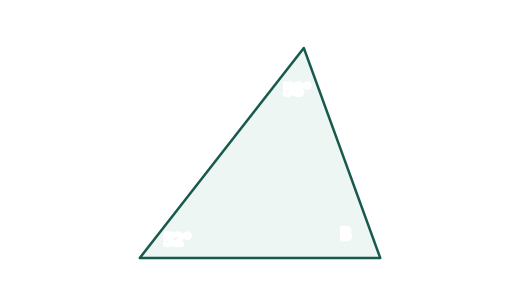
Show worked solution
Solve the whole triangle
Finding one missing measurement is only part of solving a triangle. Once you have a new angle or side, return to the diagram and mark it: the next step may now be much simpler. At the end, check the angle sum and compare the sizes of opposite sides and angles. Those checks give an independent reason to trust the calculation.
Two angles and a side
A surveyor models three landmarks as a triangle. With the measurements below, find the remaining angle and both missing sides. All lengths use the same unit.
\(A=40^\circ,\ B=65^\circ,\ a=12\)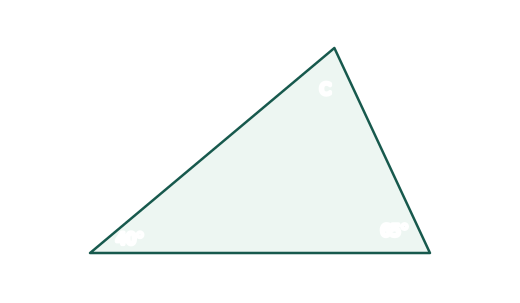
Show worked solution
Check that the largest angle is opposite the longest side. Keep full calculator precision until the final rounding.
SSA: the ambiguous case
Unlike two angles and a side, two sides and a nonincluded angle may leave more than one possible triangle. Think of the unknown vertex moving while the given measurements stay fixed. We will count the possible positions before choosing angles, so an inverse-sine calculation does not silently discard a second solution.
Given \(A,a,b\), compute \(\sin B=b\sin A/a\). A value greater than one gives no triangle. Otherwise test both \(B_1=\sin^{-1}(b\sin A/a)\) and \(B_2=180^\circ-B_1\). Keep only candidates with \(A+B<180^\circ\); count a right angle once.
| Known angle A | Conditions | Triangles |
|---|---|---|
| Acute | \(a<b\sin A\) | None |
| Acute | \(a=b\sin A\) | One, with B a right angle |
| Acute | \(b\sin A<a<b\) | Two |
| Acute | \(a\ge b\) | One |
| Right or obtuse | \(a\le b\) | None |
| Right or obtuse | \(a>b\) | One |
Inverse sine returns only its principal angle. A second triangle may use the supplementary angle.
SSA worked cases
We have seen why two triangles may fit the same data. Now check every candidate against the full triangle conditions. A supplementary angle is only a possibility: it must still leave a positive third angle and satisfy the original measurements. The sketches help explain why some candidates survive and others do not.
No triangle
A proposed triangular frame has the measurements below. Determine whether its sides can meet to form a triangle.
\(A=47^\circ,\ a=15,\ b=25\)Show worked solution
The side is too short to reach the opposite ray; no triangle exists.
Two triangles
A triangular plot is specified by the following measurements. Find every possible triangle, including its missing angles and side.
\(A=30^\circ,\ a=7,\ b=10\)Show worked solution
Both angle sums leave a positive third angle, so both triangles are valid.
An obtuse-angle check
Check whether these measurements could describe a triangle. Explain your decision using the relationship between sides and opposite angles.
\(C=93.21^\circ,\ b=c=11\)Show worked solution
An obtuse angle must face the longest side. Equal sides would force two equal obtuse angles, which is impossible. There is no triangle.
The Law of Cosines
The sine rule is convenient when we have a side and its opposite angle. What if the information is arranged differently? The cosine rule lets us work with two sides and their included angle, or with all three sides, so we can choose a method that fits the data.
\[a^2=b^2+c^2-2bc\cos A\]\[b^2=a^2+c^2-2ac\cos B,\qquad c^2=a^2+b^2-2ab\cos C\]Use the angle included between the two known sides for SAS. At a right angle the cosine term is zero, leaving the Pythagorean theorem.
SAS: find a side and angle
Two sides of a triangular frame meet at the stated angle. Find the third side and the remaining two angles.
\(b=20,\ c=30,\ A=60^\circ\)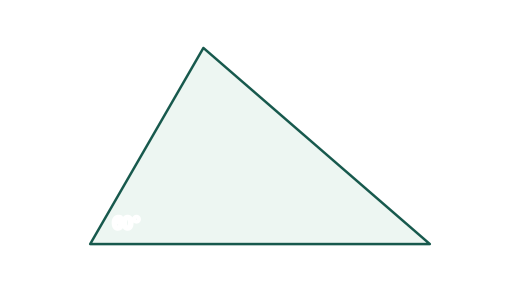
Show worked solution
Why the cosine correction and the area formula work
The cosine law extends the right-triangle distance calculation to a non-right included angle. Put \(A=(0,0),\ B=(c,0),\ C=(b\cos A,b\sin A)\) with \(0<A<180^\circ\). The side opposite A is the distance BC, so expanding squared coordinate differences gives \(a^2=(b\cos A-c)^2+(b\sin A)^2=b^2+c^2-2bc\cos A\). This also works for obtuse A, when the horizontal coordinate of C is negative.
The perpendicular height above AB is \(b\sin A\); consequently the area is \(K=\tfrac12bc\sin A\). Cyclically, \(K=\tfrac12ca\sin B=\tfrac12ab\sin C\). Dividing by the positive product \(abc/2\) gives \(\sin A/a=\sin B/b=\sin C/c\), which is the sine law. A diagram suggests these relationships; the equations explain why they hold.
Do ambiguous triangles have the same area?
Two triangles satisfy \(A=30^\circ,a=7,b=10\). Must their areas agree because the given data agree? Determine both areas.
Show worked solution
Apply the cosine law with the unknown side c: \(49=100+c^2-10\sqrt3c\). Thus \(c=5\sqrt3\pm2\sqrt6\); both values are positive. The included angle between b and c is A, so \(K=\tfrac12(10)c\sin30^\circ=\tfrac52c\). The two areas are \((25\sqrt3\pm10\sqrt6)/2\), approximately \(33.90\) and \(9.40\) square units. Equal SSA data do not determine equal areas.
Do not use half the product of two sides times the sine of an unrelated angle. The angle must be the one between those particular sides.
SSS: recover the angles
Side lengths determine shape only when a triangle exists
SSS means that all three side lengths are known. Positive lengths form a nondegenerate triangle only when each is less than the sum of the other two.
Once that check passes, the cosine law recovers an angle; starting opposite the longest side helps identify an obtuse triangle correctly.
When all three sides are known, no angle-side pair is available for the sine rule at the start. The cosine rule supplies an angle directly. Starting with the largest angle can make the remaining checks easier: it must lie opposite the largest side, and the other angles must complete the triangle sum.
\[A=\cos^{-1}\left(\frac{b^2+c^2-a^2}{2bc}\right)\]Start opposite the longest side
A triangular plot has the side lengths below. Find its largest angle and decide whether it is obtuse.
\(a=23,\ b=29,\ c=41\)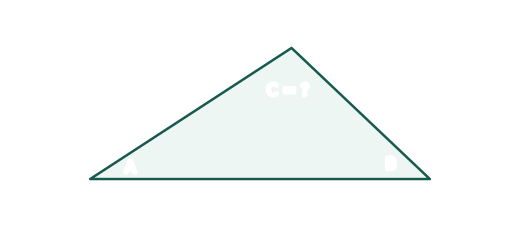
Show worked solution
The negative cosine correctly identifies an obtuse angle. Find another angle with the cosine law and use the angle sum for the last.
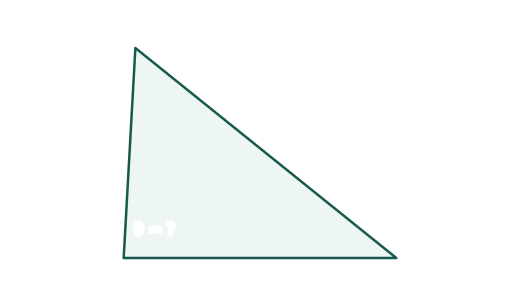
Check the substitution
Show worked solution
The same two adjacent sides must appear in both the squares and the product.
Mixed practice
Choose the law
Find side a from the following triangle measurements. Explain which law applies after finding the third angle.
\(A=100^\circ,\ B=30^\circ,\ c=2\)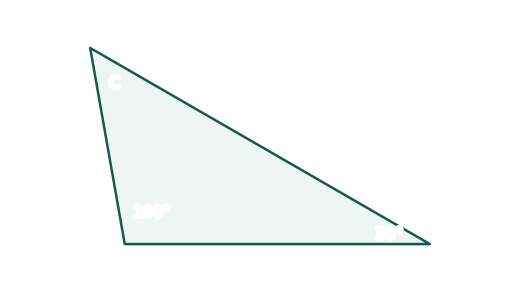
Show worked solution
Count SSA solutions
Determine how many distinct triangles satisfy these measurements.
\(A=32^\circ,\ a=8,\ b=13\)Show worked solution
Two triangles satisfy the data.
Two paths
Show worked solution
Impossible sides
Show worked solution
No. \(4+7<12\), so they cannot close to form a triangle.
Additional practice: mixed exercises
Count the possible triangles
Use opposite-side notation. Determine whether there are zero, one, or two triangles and justify your answer.
- \(A=87^\circ,\ a=47,\ b=50\).
- \(B=113^\circ,\ b=49,\ a=54\).
- \(C=37^\circ,\ c=28,\ b=32\).
- \(C=47^\circ,\ c=20,\ a=12\).
- \(C=97^\circ,\ c=45,\ a=39\).
- \(A=114^\circ,\ a=21,\ b=32\).
- \(A=32^\circ,\ a=8,\ b=13\).
- \(B=30^\circ,\ b=12,\ a=24\).
- \(A=67^\circ,\ a=18,\ b=20\).
Show worked solution
- None: the altitude \(50\sin87^\circ\approx49.93\) exceeds \(47\).
- None: the side opposite an obtuse angle must be longest, but \(49<54\).
- Two: \(32\sin37^\circ\approx19.26<28<32\).
- One: the given angle is acute and its opposite side \(20\) is at least \(12\).
- One: the given angle is obtuse and \(45>39\).
- None: \(21<32\) although \(A\) is obtuse.
- Two: \(13\sin32^\circ\approx6.89<8<13\).
- One right triangle: \(24\sin30^\circ=12\).
- None: \(20\sin67^\circ\approx18.41>18\).
Choose and apply a law
Use opposite-side notation. Round to two decimals.
- \(A=98.4^\circ, B=24.6^\circ, a=376\). Find \(c\).
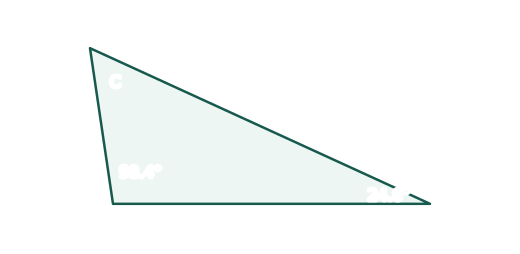
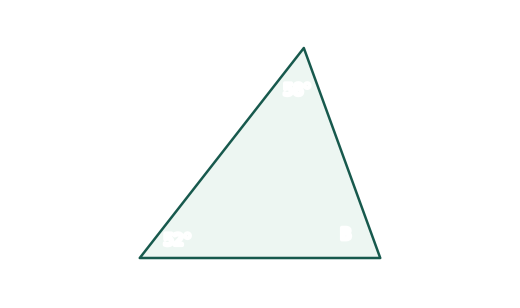
Known measurements and unknowns are labeled. Equal scale on both axes. - \(A=52^\circ,B=70^\circ,c=26.7\). Find \(a\).
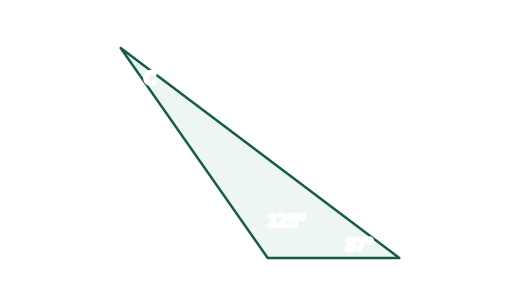
Known measurements and unknowns are labeled. Equal scale on both axes. - \(A=125^\circ,B=37^\circ,b=16\). Find \(a\).
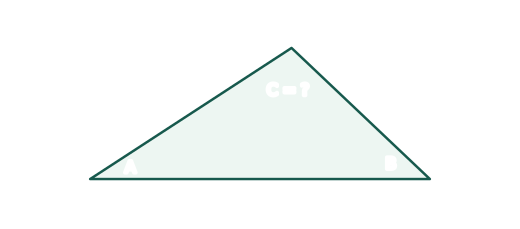
Known measurements and unknowns are labeled. Equal scale on both axes. - \(a=23,b=29,c=41\). Find \(C\).
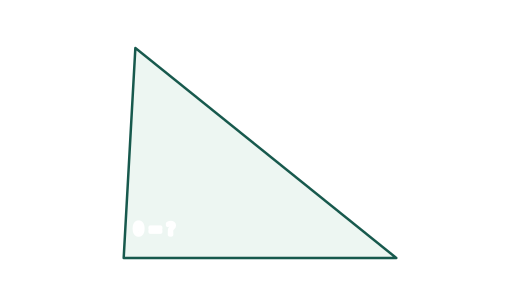
Known measurements and unknowns are labeled. Equal scale on both axes. - Sides \(27\) and \(35\) enclose angle \(\theta\) opposite side \(43\). Find \(\theta\).
Known measurements and unknowns are labeled. Equal scale on both axes.
Show worked solution
- \(C=57^\circ\); \(c=376\sin57^\circ/\sin98.4^\circ\approx318.76\).
- \(C=58^\circ\); \(a=26.7\sin52^\circ/\sin58^\circ\approx24.81\).
- \(a=16\sin125^\circ/\sin37^\circ\approx21.78\).
- \(\cos C=(23^2+29^2-41^2)/(2\cdot23\cdot29)=-311/1334\), so \(C\approx103.48^\circ\).
- \(\cos\theta=(27^2+35^2-43^2)/(2\cdot27\cdot35)=1/18\), so \(\theta\approx86.82^\circ\).
Triangle diagram exercises: missing sides
Each statement includes the measurements from the diagram. Use opposite-side notation. Round lengths to two decimals.
- \(A=48^\circ,B=61^\circ,c=21\) cm. Find \(b\).
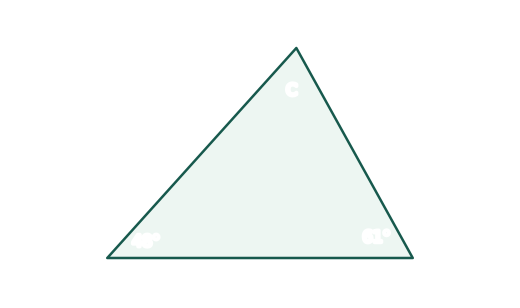
Known measurements and unknowns are labeled. Equal scale on both axes. - In triangle \(PQR\), \(Q=79^\circ,R=69^\circ\), and \(PR=18\) cm. Find \(QR\).
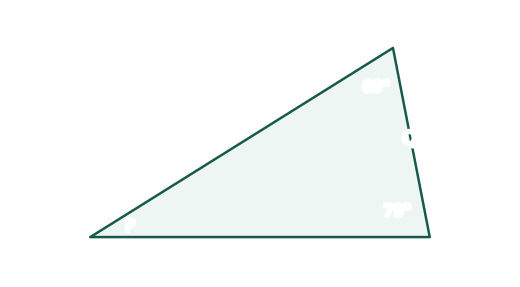
Known measurements and unknowns are labeled. Equal scale on both axes. - In triangle \(XYZ\), \(Y=29^\circ,Z=112^\circ\), and \(YZ=8\) cm. Find \(XY\).
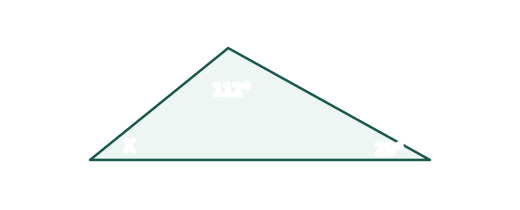
Known measurements and unknowns are labeled. Equal scale on both axes. - In triangle \(ABC\), \(A=118^\circ,B=22^\circ\), and \(AB=24\). Find \(AC\).
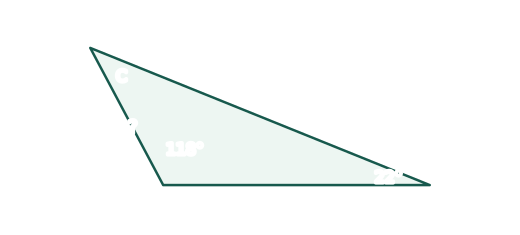
Known measurements and unknowns are labeled. Equal scale on both axes. - Two sides of lengths \(17\) and \(22\) m enclose an angle of \(42^\circ\). Find the opposite side \(x\).
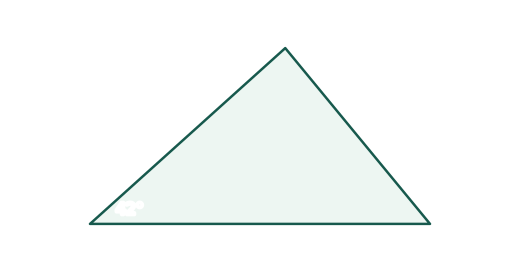
Known measurements and unknowns are labeled. Equal scale on both axes. - Two sides of lengths \(23\) and \(20\) m enclose an angle of \(47^\circ\). Find the opposite side \(x\).
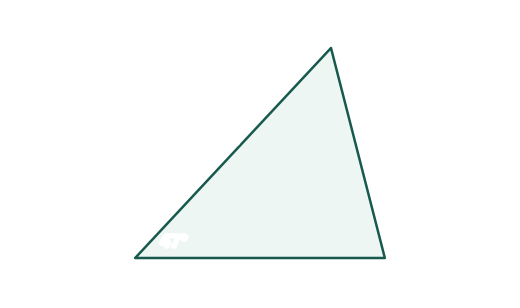
Known measurements and unknowns are labeled. Equal scale on both axes.
Show worked solution
- \(C=180^\circ-48^\circ-61^\circ=71^\circ\). By the sine law, \(b=21\sin61^\circ/\sin71^\circ\approx19.43\) cm.
- \(P=32^\circ\). Thus \(QR=18\sin32^\circ/\sin79^\circ\approx9.72\) cm.
- \(X=39^\circ\). Hence \(XY=8\sin112^\circ/\sin39^\circ\approx11.79\) cm.
- \(C=40^\circ\). Thus \(AC=24\sin22^\circ/\sin40^\circ\approx13.99\).
- Use the cosine law: \(x=\sqrt{17^2+22^2-2\cdot17\cdot22\cos42^\circ}\approx14.74\) m.
- Use the cosine law: \(x=\sqrt{23^2+20^2-2\cdot23\cdot20\cos47^\circ}\approx17.37\) m.
Triangle diagram exercises: missing angles
A drawing alone does not rule out a second SSA triangle. Find every angle allowed by the stated measurements.
- An angle of \(42^\circ\) is opposite side \(17\). Find \(x\) opposite side \(22\).
- An angle of \(62^\circ\) is opposite side \(110\). Find \(Y\) opposite side \(108\).
- An angle of \(63^\circ\) is opposite side \(5.5\). Find \(B\) opposite side \(4.7\).
- An angle of \(50^\circ\) is opposite side \(29\). Find \(A\) opposite side \(32\).
- In triangle \(LMN\), \(N=60^\circ\), \(LM=4.8\) cm, and \(MN=5.3\) cm. Find \(M\).
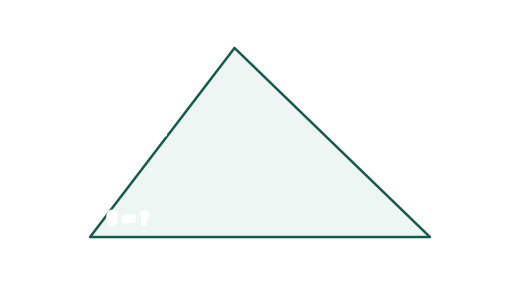
- Find the angle \(\theta\) between sides \(7\) and \(10\) cm, opposite side \(8\) cm.
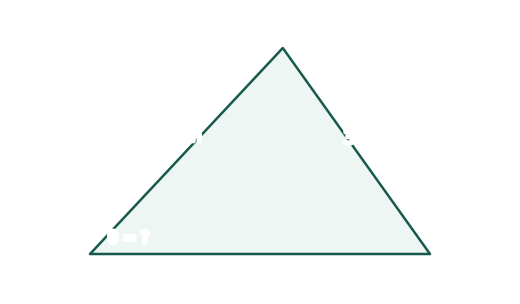
Known measurements and unknowns are labeled. Equal scale on both axes. - Find the angle \(\theta\) between sides \(39\) and \(47\) mm, opposite side \(35\) mm.
Known measurements and unknowns are labeled. Equal scale on both axes. - Find the angle \(\theta\) between sides \(9.4\) and \(7\) cm, opposite side \(13\) cm.
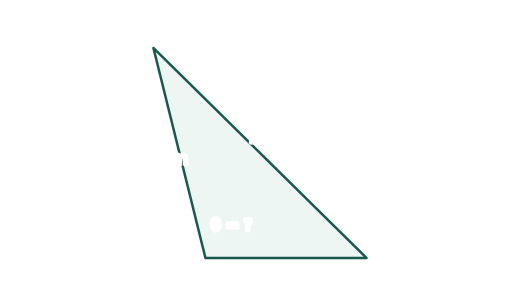
Known measurements and unknowns are labeled. Equal scale on both axes. - Solve the triangle with \(a=19.39,c=8.32,B=55^\circ\).
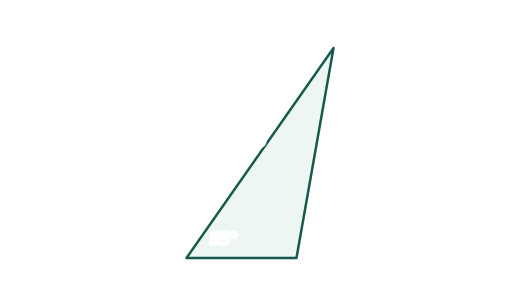
Known measurements and unknowns are labeled. Equal scale on both axes.
Show worked solution
- \(\sin x=22\sin42^\circ/17\). The principal answer is \(59.99^\circ\). Its supplement \(120.01^\circ\) also leaves a positive third angle, so both are possible.
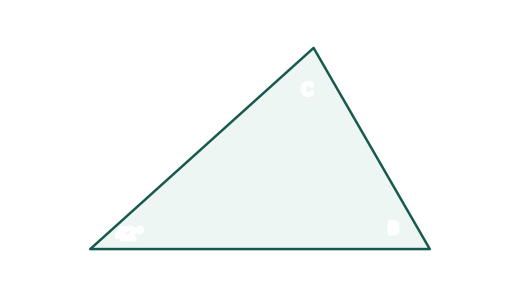
Known measurements and unknowns are labeled. Equal scale on both axes. 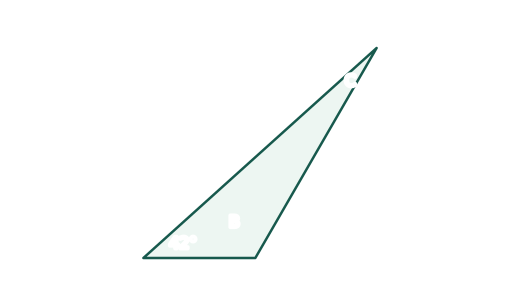
Known measurements and unknowns are labeled. Equal scale on both axes. - \(\sin Y=108\sin62^\circ/110\). The principal answer is \(60.1^\circ\). The supplement \(119.9^\circ\) would make the angle sum at least \(180^\circ\), so reject it.
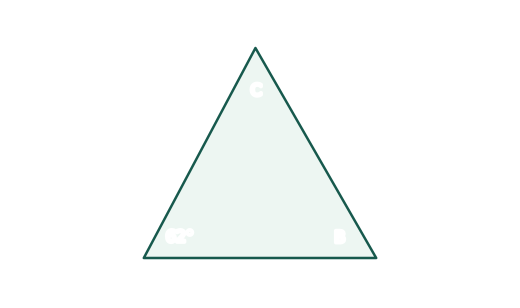
Known measurements and unknowns are labeled. Equal scale on both axes. - \(\sin B=4.7\sin63^\circ/5.5\). The principal answer is \(49.59^\circ\). The supplement \(130.41^\circ\) would make the angle sum at least \(180^\circ\), so reject it.
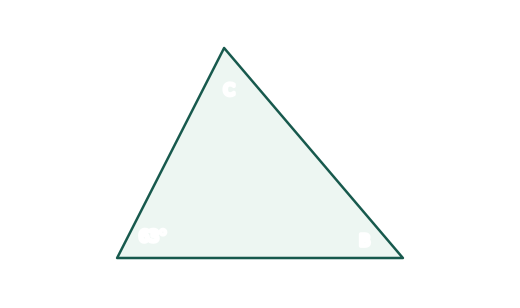
Known measurements and unknowns are labeled. Equal scale on both axes. - \(\sin A=32\sin50^\circ/29\). The principal answer is \(57.7^\circ\). Its supplement \(122.3^\circ\) also leaves a positive third angle, so both are possible.
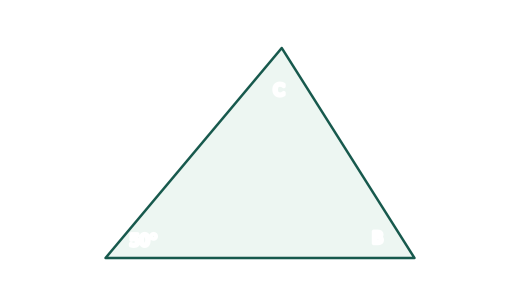
Known measurements and unknowns are labeled. Equal scale on both axes. 
Known measurements and unknowns are labeled. Equal scale on both axes. - \(\sin L=5.3\sin60^\circ/4.8\). Both \(L\approx72.99^\circ\) and its supplement are possible. Subtract each from \(120^\circ\): \(M\approx47.01^\circ\) or \(12.99^\circ\).
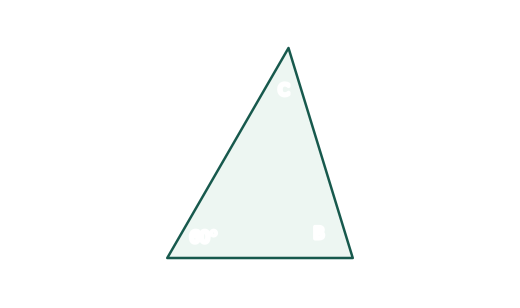
Known measurements and unknowns are labeled. Equal scale on both axes. 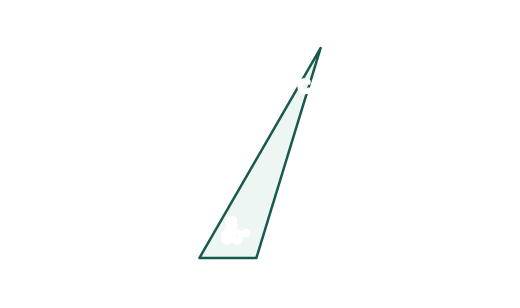
Known measurements and unknowns are labeled. Equal scale on both axes. - \(\cos\theta=(7^2+10^2-8^2)/(2\cdot7\cdot10)\). Thus \(\theta\approx52.62^\circ\).
- \(\cos\theta=(39^2+47^2-35^2)/(2\cdot39\cdot47)\). Thus \(\theta\approx46.9^\circ\).
- \(\cos\theta=(9.4^2+7^2-13^2)/(2\cdot9.4\cdot7)\). Thus \(\theta\approx103.91^\circ\).
- First \(b=\sqrt{19.39^2+8.32^2-2(19.39)(8.32)\cos55^\circ}\approx16.13\). Then \(A=\arccos((b^2+8.32^2-19.39^2)/(2b\cdot8.32))\approx100^\circ\) and \(C=180^\circ-55^\circ-A\approx25^\circ\).
Takeaways and connections
- Identify the data pattern before selecting a law.
- Pair each side with its opposite angle.
- Test both SSA candidates and avoid rounding intermediate values.
Reasoning, connections and deeper practice
The laws determine more than missing measurements. They let us test whether a proposed triangle is possible and explain why an ambiguous measurement can describe two different shapes. Use the SSA explorer to compare the cases after working them out.
Reasoning · Locate the change in the number of triangles
A survey fixes \(A=30^\circ\) and \(b=10\) m, but the measured opposite side \(a\) varies. Classify all positive values of \(a\) by whether they give zero, one or two nondegenerate triangles. Include the boundary cases.
Hint
The minimum reach is the altitude \(b\sin A\). A second candidate must leave a positive third angle.
Show worked solution
The altitude is \(10\sin30^\circ=5\) m. For \(0<a<5\), there is no triangle. At \(a=5\), \(B=90^\circ\) gives exactly one. For \(5<a<10\), both sine candidates leave a positive third angle, so there are two. At \(a=10\), the candidates for \(B\) are \(30^\circ\) and \(150^\circ\); the latter leaves \(C=0\) and is rejected. For \(a>10\), the supplementary candidate also fails. Thus \(a\ge10\) gives one. The strict angle-sum check prevents counting a collapsed triangle.
Advanced / Honors · Recover the triangle type without inverse trigonometry
For positive lengths \(a,b,c\) satisfying the strict triangle inequalities, with \(c\) the longest, prove that the triangle is acute, right or obtuse according as \(c^2\) is less than, equal to or greater than \(a^2+b^2\). Apply this to \(7,8,12\).
Hint
Solve the cosine law for the cosine of the largest angle and use its sign.
Show worked solution
The largest angle \(C\) is opposite \(c\), and \(\cos C=(a^2+b^2-c^2)/(2ab)\). The denominator is positive. On \((0,\pi)\), cosine is positive, zero or negative exactly for acute, right or obtuse angles. If the largest angle is acute, all are acute; otherwise it determines the type. For \(7,8,12\), \(7+8>12\) ensures existence and \(144>49+64=113\), so the triangle is obtuse. Testing the inequality alone without checking existence would not justify a triangle classification.