Trigonometric Ratios & Right Triangles
Connect side ratios to angles, solve right triangles, and model heights, shadows, ladders, and supporting wires.
What you will learn
- Label the hypotenuse, opposite side, and adjacent side relative to an acute angle.
- Find all six trigonometric ratios, including exact radical values.
- Choose a ratio to find a missing side or angle.
- Solve right triangles and interpret an answer in its real-world setting.
Sides depend on the chosen angle
Before using a ratio, point to the angle the question is about. The hypotenuse stays opposite the right angle, but the names opposite and adjacent depend on your chosen acute angle. Try switching your attention to the other acute angle: the two legs exchange roles. This is why a correct sketch comes before choosing a formula.
In a right triangle, the hypotenuse is opposite the right angle and is the longest side. The opposite and adjacent legs depend on the selected acute angle \(\theta\). The adjacent leg is not the hypotenuse.
\[a^2+b^2=c^2\]Here \(c\) is the hypotenuse. For acute angles \(A\) and \(B\), \(A+B=90^\circ\).
The six ratios
We have identified the sides relative to a chosen angle. The important observation is that similar right triangles keep the same side ratios even when their sizes change. That makes a ratio useful for describing an angle rather than one particular triangle.
| Ratio | Definition | Reciprocal |
|---|---|---|
| \(\sin\theta\) | \(\frac{\text{opposite}}{\text{hypotenuse}}\) | \(\csc\theta=\frac{\text{hypotenuse}}{\text{opposite}}\) |
| \(\cos\theta\) | \(\frac{\text{adjacent}}{\text{hypotenuse}}\) | \(\sec\theta=\frac{\text{hypotenuse}}{\text{adjacent}}\) |
| \(\tan\theta\) | \(\frac{\text{opposite}}{\text{adjacent}}\) | \(\cot\theta=\frac{\text{adjacent}}{\text{opposite}}\) |
SOH–CAH–TOA recalls sine, cosine, and tangent. The reciprocal ratios reverse those fractions.
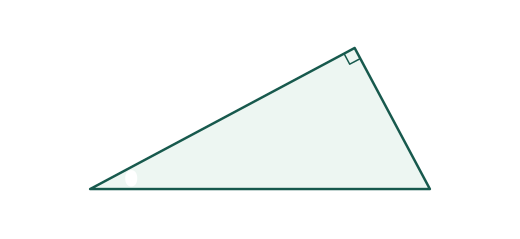
An exact triangle
Show worked solution
The hypotenuse is \(17\), the adjacent leg is \(15\). Thus
\[\sin\theta=\frac8{17},\quad\cos\theta=\frac{15}{17},\quad\tan\theta=\frac8{15}\]\[\csc\theta=\frac{17}8,\quad\sec\theta=\frac{17}{15},\quad\cot\theta=\frac{15}8\]Recover a missing side before forming ratios
A problem may give only two sides, but the six trigonometric ratios refer to all three. First use the right-angle condition to complete the triangle, then form the ratios relative to the requested angle. This separates the geometric information from the ratio bookkeeping.
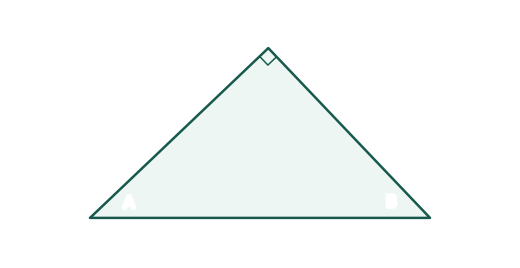
Given a sine ratio
Show worked solution
Take opposite \(A\) as \(20\) and hypotenuse as \(29\). The other leg is
\[\sqrt{29^2-20^2}=\sqrt{441}=21\]Relative to \(B\), the opposite side is \(21\) and the adjacent side is \(20\). Therefore
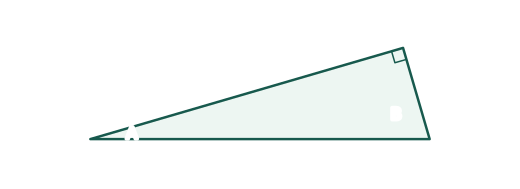
\[\cos A=\frac{21}{29},\quad\cot B=\frac{20}{21},\quad\csc B=\frac{29}{21}\]Given a cosine ratio
Show worked solution
Before switching from one acute angle to the other, relabel the two legs. The hypotenuse stays the same.
Exact values with radicals
Exact values and approximations
An exact value specifies a quantity without rounding; a radical can do this even when its decimal expansion does not terminate.
Keep exact expressions during a calculation when possible and round only the requested result. This avoids small intermediate errors accumulating across several steps.
A decimal approximation is useful for measurement, but it can hide an exact relationship. Keep radicals in the calculation when the question asks for exact values. Simplify only through valid equalities, and wait until the end to round if an approximation is requested.
Start from a tangent
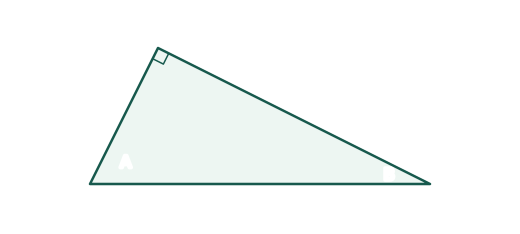
Show worked solution
Choose legs \(2\) and \(1\); the hypotenuse is \(\sqrt{2^2+1^2}=\sqrt5\).
\[\cos A=\frac1{\sqrt5}=\frac{\sqrt5}{5},\qquad\sin B=\frac1{\sqrt5}=\frac{\sqrt5}{5}\]Start from a secant
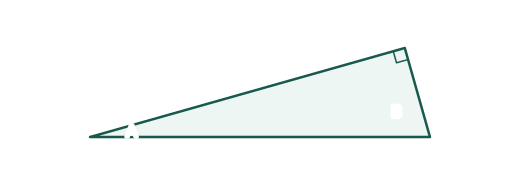
Show worked solution
Use hypotenuse \(3\sqrt6\) and adjacent-to-\(B\) leg \(2\).
\[\text{other leg}=\sqrt{54-4}=5\sqrt2\]\[\tan A=\frac2{5\sqrt2}=\frac{\sqrt2}{5},\quad\sin A=\frac2{3\sqrt6}=\frac{\sqrt6}{9}\]Find missing sides
We have formed ratios from known sides; now let us use a ratio as an equation with one unknown. Name the known side and the side you want, then select a ratio containing both. Estimate the answer from the picture before using a calculator: a leg longer than the hypotenuse is a signal to revisit the setup.
Use \(a\) opposite \(A\), \(b\) opposite \(B\), and \(c\) opposite the right angle. Label known and unknown quantities, select a ratio that contains both, solve algebraically, then calculate in degree mode.
Given an angle and hypotenuse
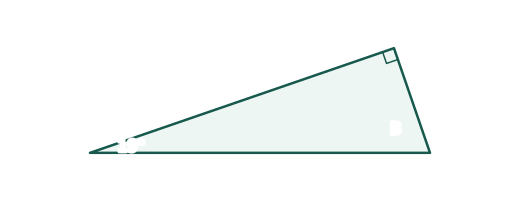
Show worked solution
Given an angle and opposite leg
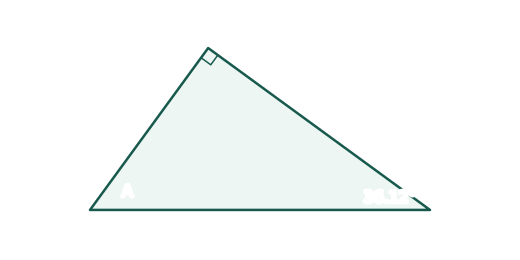
Show worked solution
Keep extra calculator digits until the final answer. Check that the hypotenuse is longer than either leg.
Find an angle using inverse ratios
Undoing a ratio
An inverse trigonometric function is the inverse of a trigonometric function restricted to an interval on which it is one-to-one. Its specified principal range selects one angle among those with the required ratio.
In a right triangle, the angle sought is acute, which selects the appropriate answer. The inverse sine is not the reciprocal of sine; the reciprocal is cosecant.
Until now the angle helped us recover a side. We can also work in the other direction: a known ratio can tell us the angle. First identify which two sides are involved, then choose the inverse operation that matches that ratio.
Use an inverse trigonometric function to recover an angle from its ratio. For an acute right-triangle angle, choose \(\sin^{-1}\), \(\cos^{-1}\), or \(\tan^{-1}\) according to the known sides.
\(\sin^{-1}x\) means arcsine, not \(1/\sin x\). The reciprocal of sine is cosecant. Set the calculator to degrees for this lesson.
Adjacent and hypotenuse
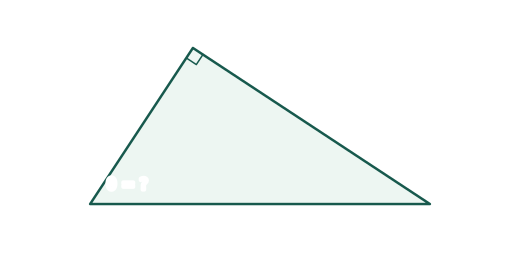
Show worked solution
Two legs
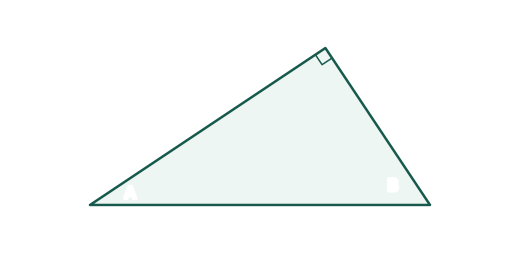
Show worked solution
Leg and hypotenuse
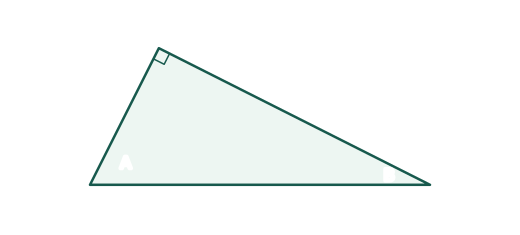
Show worked solution
Model a height, ladder, or wire
A word problem rarely arrives with its triangle already labeled. Begin by deciding what is horizontal, what is vertical, and where the right angle belongs. Once the picture is clear, selecting a trigonometric ratio becomes a much smaller task.
Draw the situation first. Assume level ground and a vertical object when those are the stated conditions. An angle of elevation is measured upward from a horizontal line.
A tree and its shadow
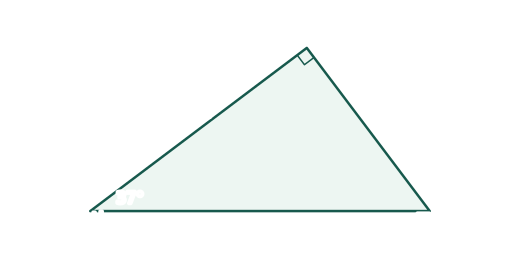
Show worked solution
The height is opposite the angle; the shadow is adjacent.
\[\tan37^\circ=\frac h{120}\quad\Rightarrow\quad h=120\tan37^\circ\approx90.43\text{ ft}\]A ladder against a wall
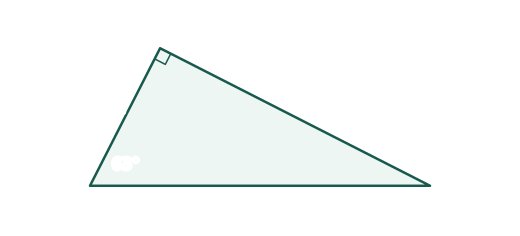
Show worked solution
The ladder is the hypotenuse, so use cosine.
\[\cos63^\circ=\frac{11}{L}\quad\Rightarrow\quad L=\frac{11}{\cos63^\circ}\approx24.23\text{ ft}\]Angle of a supporting wire
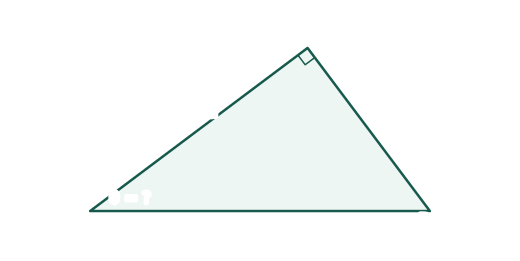
Show worked solution
Check what your measured angle can tell you
A trigonometric model needs a right triangle whose sides match the measured quantities. An angle of depression is measured downward from the observer’s horizontal line. On level ground, that line is parallel to the ground, so the depression angle equals the elevation angle at the target. It is not the angle between the sight line and a vertical wall.
A camera looking down
A camera is \(12\) m vertically above level ground. It views a marker at a depression angle of \(30^\circ\). Find the marker’s horizontal distance from the point directly below the camera. Explain what changes if the angle is larger.
Show worked solution
The vertical drop is opposite the equal ground angle, so \(\tan30^\circ=12/d\). Hence \(d=12\sqrt3\approx20.78\) m. For a fixed height, a larger acute depression angle has a larger tangent and therefore a smaller horizontal distance. The sight-line length is a different quantity: \(12/\sin30^\circ=24\) m.
Measurements also have uncertainty. Reporting many calculator digits does not make an approximate input exact. Because tangent increases through the acute-angle interval, lower and upper angle bounds give lower and upper height bounds when the horizontal distance is fixed.
A height interval instead of false precision
A roof is observed from \(20\) m away on level ground at eye height \(1.5\) m. The elevation is between \(30^\circ\) and \(31^\circ\) inclusive. Give an interval for the roof height.
Show worked solution
Use \(h=1.5+20\tan\theta\) at both endpoints. The exact interval is \([1.5+20\tan30^\circ,\ 1.5+20\tan31^\circ]\) m, approximately \([13.047,13.517]\) m. These decimals describe the bounds approximately; they are not an exact measured height. No single value is determined by the information.
The inverse sine button returns an angle; it does not take a reciprocal. Similar triangles have equal ratios but can have different lengths and areas. A side enlargement by a factor s multiplies area by s², not by s.
Practice: choose, solve, and explain
1 · Six ratios
Show worked solution
Use opposite \(5\), hypotenuse \(13\), adjacent \(\sqrt{169-25}=12\).
\[\sin A=\frac5{13},\ \cos A=\frac{12}{13},\ \tan A=\frac5{12},\ \sec A=\frac{13}{12},\ \cot A=\frac{12}5\]2 · Solve a triangle
Show worked solution
3 · Find a shadow
Show worked solution
4 · Choose an inverse
Show worked solution
5 · A taut string
Show worked solution
6 · Diagnose an impossible ratio
Show worked solution
The opposite leg is shorter than the hypotenuse. Their ratio must lie strictly between zero and one. Check whether the fraction was inverted or the sides were mislabeled.
7 · Complementary angles
Show worked solution
Angle \(B\) is opposite the side of length \(12\), so \(\tan B=12/5\). The opposite and adjacent legs switch.
Additional practice: mixed exercises
Inverse-ratio and entrance practice
Use degrees. Round lengths to two decimals and angles to the nearest tenth, except where two decimals are requested.
- In right triangle \(TUV\), \(U=90^\circ\), \(T=70^\circ\), and \(UT=64\). Find \(UV\).
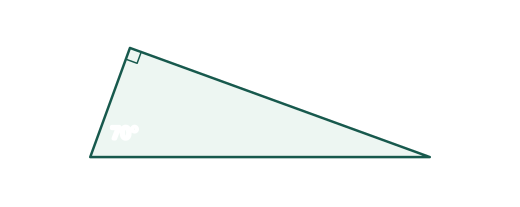
Known measurements and unknowns are labeled. Equal scale on both axes. - In a separate right triangle \(TUV\), \(U=90^\circ\), \(T=40^\circ\), and \(TU=64\). Find \(TV\).
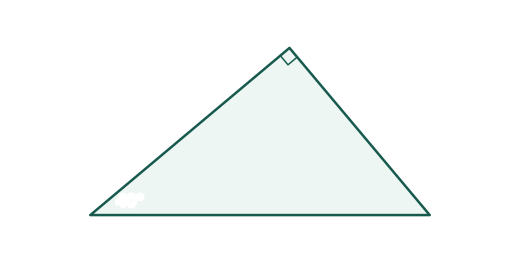
Known measurements and unknowns are labeled. Equal scale on both axes. - In right triangle \(BCD\), \(C=90^\circ\), \(BD=7.4\), and \(CD=5.6\). Find angle \(B\).
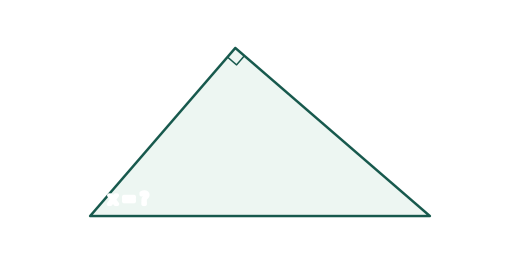
Known measurements and unknowns are labeled. Equal scale on both axes. - In right triangle \(MNO\), \(N=90^\circ\), \(ON=1.8\), and \(MN=1\). Find angle \(M\).
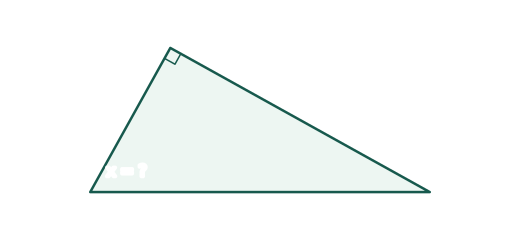
Known measurements and unknowns are labeled. Equal scale on both axes. - In right triangle \(UVW\), \(V=90^\circ\), \(UV=4.4\), and \(UW=7.1\). Find angle \(W\).
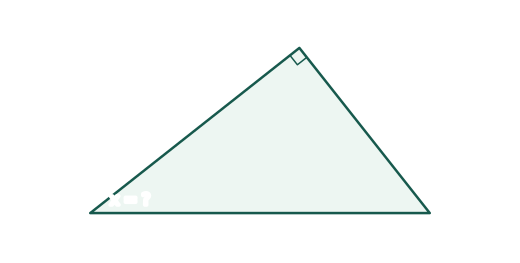
Known measurements and unknowns are labeled. Equal scale on both axes. - For acute angles, solve \(\sin\beta=0.1115\) and \(\cos\gamma=0.8988\). Give two decimal places.
Show worked solution
- \(UV\) is opposite \(T\), so \(\tan70^\circ=UV/64\). Thus \(UV=64\tan70^\circ\approx175.84\).
- \(TV\) is the hypotenuse. Hence \(\cos40^\circ=64/TV\) and \(TV=64/\cos40^\circ\approx83.55\).
- \(\sin B=5.6/7.4\), so \(B=\arcsin(5.6/7.4)\approx49.2^\circ\).
- \(\tan M=1.8/1\), so \(M=\arctan(1.8)\approx60.9^\circ\).
- \(\sin W=4.4/7.1\), so \(W=\arcsin(4.4/7.1)\approx38.3^\circ\).
- Apply the corresponding inverse function: \(\beta=\arcsin(0.1115)\approx6.40^\circ\) and \(\gamma=\arccos(0.8988)\approx26.00^\circ\).
Name the sides
Name the opposite leg, adjacent leg, and hypotenuse relative to the stated angle. Sketch the triangle from the labels first.
- Triangle \(ABC\) has a right angle at \(B\). Use the acute angle at \(C\).
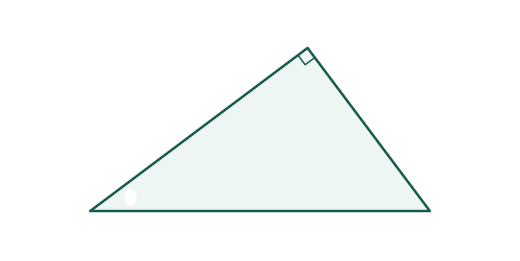
Known measurements and unknowns are labeled. Equal scale on both axes. - Triangle \(PQR\) has a right angle at \(Q\). Use the acute angle at \(R\).
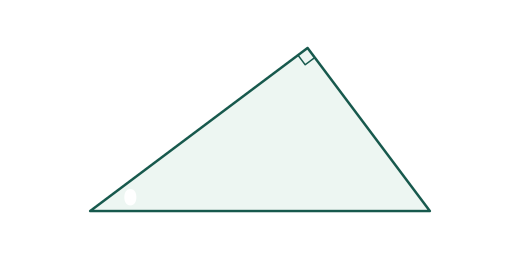
Known measurements and unknowns are labeled. Equal scale on both axes. - Triangle \(XYZ\) has a right angle at \(Z\). Use the acute angle at \(X\).
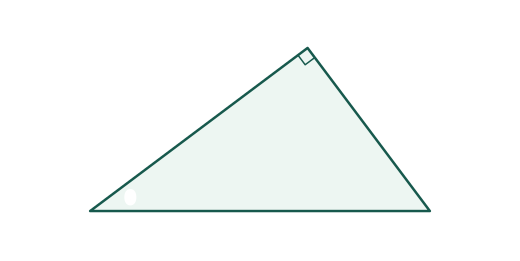
Known measurements and unknowns are labeled. Equal scale on both axes. - Triangle \(LMN\) has a right angle at \(M\). Use the acute angle at \(N\).
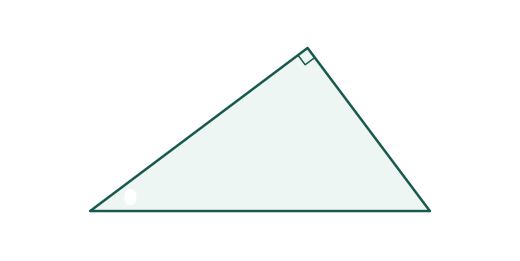
Known measurements and unknowns are labeled. Equal scale on both axes.
Show worked solution
- Opposite: \(AB\); adjacent leg: \(BC\); hypotenuse: \(AC\). The hypotenuse is opposite the right angle; the opposite leg does not touch the selected acute angle.
- Opposite: \(PQ\); adjacent leg: \(QR\); hypotenuse: \(PR\). The hypotenuse is opposite the right angle; the opposite leg does not touch the selected acute angle.
- Opposite: \(YZ\); adjacent leg: \(XZ\); hypotenuse: \(XY\). The hypotenuse is opposite the right angle; the opposite leg does not touch the selected acute angle.
- Opposite: \(LM\); adjacent leg: \(MN\); hypotenuse: \(LN\). The hypotenuse is opposite the right angle; the opposite leg does not touch the selected acute angle.
Complete the ratio sets
All named angles are acute; paired angles are complementary.
- In an \(8,15,17\) right triangle, \(\alpha\) is opposite the side of length \(15\) and \(\beta\) is opposite the side of length \(8\). Find \(\sin\alpha,\cos\beta,\tan\beta,\csc\alpha,\sec\beta,\cot\beta\).
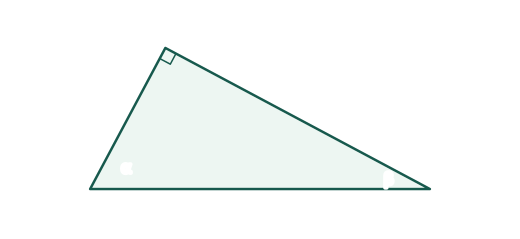
Known measurements and unknowns are labeled. Equal scale on both axes. - A right triangle has legs \(5,12\) and hypotenuse \(x\). Angle \(\alpha\) is opposite the side \(5\), and \(\beta\) is opposite the side \(12\). Find \(x,\cos\alpha,\tan\beta,\sin\alpha\).
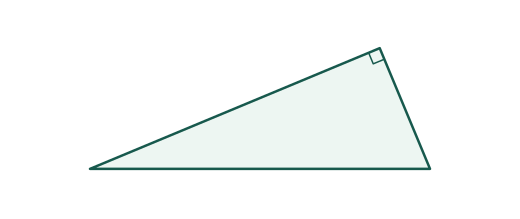
Known measurements and unknowns are labeled. Equal scale on both axes. - In triangle \(MNP\), \(M=90^\circ\), \(MN=9\), \(MP=12\), \(NP=15\). Find \(\cos N,\sin N,\tan N,\sec P,\cot P,\csc P\).
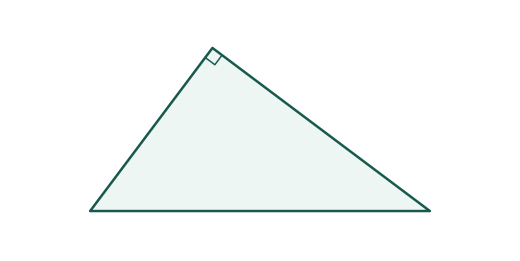
Known measurements and unknowns are labeled. Equal scale on both axes. - Given \(\cos B=7/25\), find the other five ratios.
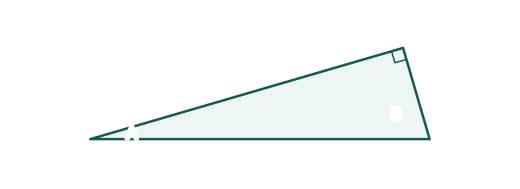
Known measurements and unknowns are labeled. Equal scale on both axes. - Given \(\sec B=3\sqrt6/2\) and \(A+B=90^\circ\), find \(\tan A,\sin A,\csc B\).
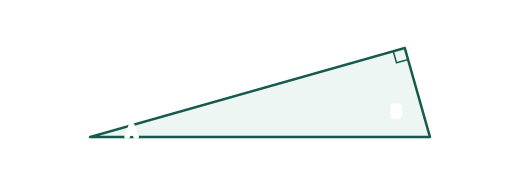
Known measurements and unknowns are labeled. Equal scale on both axes. - Given \(\tan A=2\) and \(A+B=90^\circ\), find \(\cos A,\sec B,\sin B\).
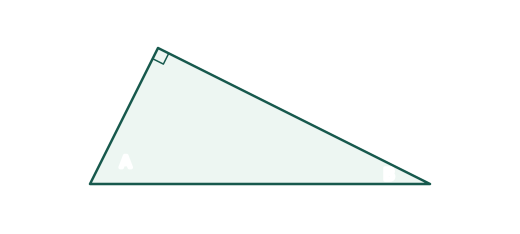
Known measurements and unknowns are labeled. Equal scale on both axes. - In right triangle \(BCD\), \(C=90^\circ\), \(D=72^\circ\), and \(CD=13\). Find \(BC=x\) to the nearest tenth.
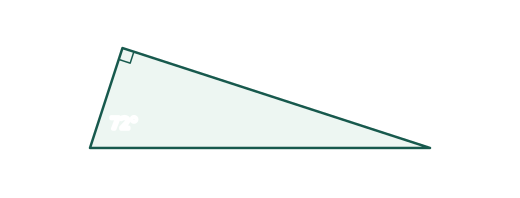
Known measurements and unknowns are labeled. Equal scale on both axes. - In right triangle \(LMN\), \(M=90^\circ\), \(L=20^\circ\), and \(LM=52\). Find \(LN=x\) to the nearest tenth.
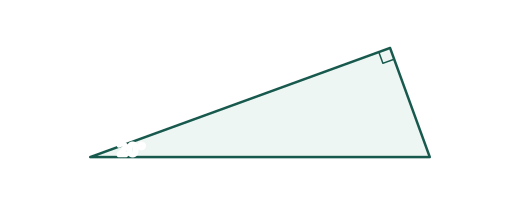
Known measurements and unknowns are labeled. Equal scale on both axes.
Show worked solution
- For \(\alpha\), opposite/hypotenuse is \(15/17\). For \(\beta\), adjacent is \(15\) and opposite is \(8\). Therefore the requested values, in order, are \(15/17,15/17,8/15,17/15,17/15,15/8\). The last three are reciprocals of the first three.
- \(x=\sqrt{5^2+12^2}=13\). Then \(\cos\alpha=12/13\), \(\tan\beta=12/5\), and \(\sin\alpha=5/13\).
- Relative to \(N\), adjacent is \(9\) and opposite is \(12\). Relative to \(P\), adjacent is \(12\) and opposite is \(9\). The six answers are \(9/15=3/5\), \(12/15=4/5\), \(12/9=4/3\), \(15/12=5/4\), \(12/9=4/3\), and \(15/9=5/3\).
- Take adjacent \(7\) and hypotenuse \(25\). The opposite leg is \(\sqrt{625-49}=24\). Thus \(\sin B=24/25\), \(\tan B=24/7\), \(\csc B=25/24\), \(\sec B=25/7\), \(\cot B=7/24\).
- Choose adjacent to \(B\) as \(2\) and hypotenuse as \(3\sqrt6\). The remaining leg is \(\sqrt{54-4}=5\sqrt2\). Hence \(\tan A=2/(5\sqrt2)=\sqrt2/5\), \(\sin A=2/(3\sqrt6)=\sqrt6/9\), and \(\csc B=3\sqrt6/(5\sqrt2)=3\sqrt3/5\).
- Choose opposite-to-\(A\) leg \(2\) and adjacent leg \(1\), giving hypotenuse \(\sqrt5\). Therefore \(\cos A=1/\sqrt5=\sqrt5/5\), \(\sec B=\sqrt5/2\), and \(\sin B=1/\sqrt5=\sqrt5/5\).
- Relative to \(D\), \(x\) is opposite and \(13\) is adjacent. Thus \(\tan72^\circ=x/13\), so \(x=13\tan72^\circ\approx40.0\).
- The unknown is the hypotenuse. \(\cos20^\circ=52/x\) gives \(x=52/\cos20^\circ\approx55.3\).
Reciprocal-ratio drill
Let \(\theta\) be acute. Find the requested ratio.
- \(\sec\theta=29/20\). Find \(\cos\theta\).
- \(\csc\theta=41/40\). Find \(\sin\theta\).
- \(\cot\theta=30/16\). Find \(\tan\theta\).
- \(\tan\theta=7/24\). Find \(\cot\theta\).
- \(\cos\theta=15/17\). Find \(\sec\theta\).
Show worked solution
- Take the reciprocal: \(\cos\theta=20/29\).
- \(\sin\theta=1/\csc\theta=40/41\).
- \(\tan\theta=16/30=8/15\).
- \(\cot\theta=24/7\).
- \(\sec\theta=17/15\).
Solve right triangles
In \(\triangle ABC\), \(C=90^\circ\) and lowercase sides are opposite their matching angles. Find all missing sides and angles. Round lengths to two decimals.
- \(A=19^\circ,\ c=70\).
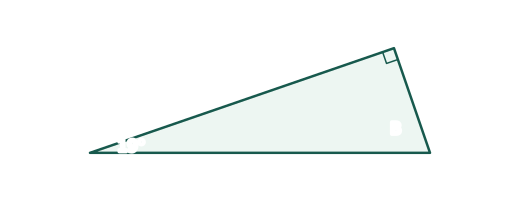
Known measurements and unknowns are labeled. Equal scale on both axes. - \(B=36.12^\circ,\ b=27.2\).
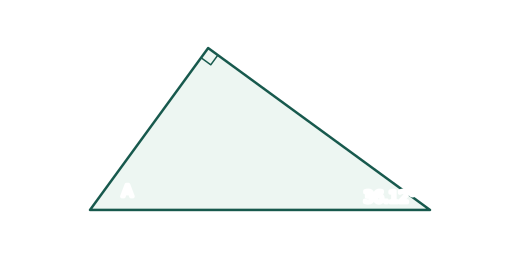
Known measurements and unknowns are labeled. Equal scale on both axes. - \(A=12.4^\circ,\ b=98.1\).
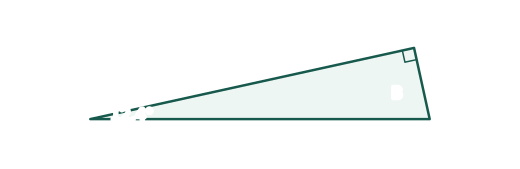
Known measurements and unknowns are labeled. Equal scale on both axes. - \(B=25.3^\circ,\ a=37\).
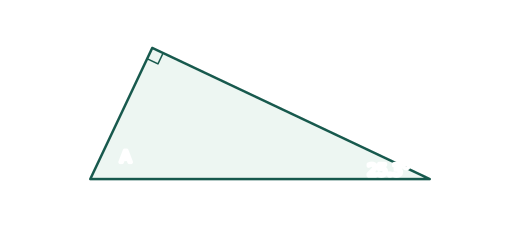
Known measurements and unknowns are labeled. Equal scale on both axes. - \(a=12,\ b=18\).
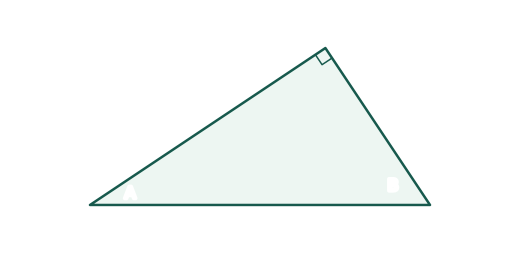
Known measurements and unknowns are labeled. Equal scale on both axes. - \(b=1.8,\ c=4\).
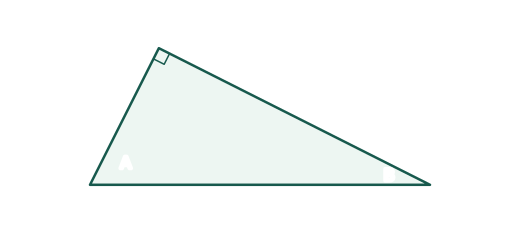
Known measurements and unknowns are labeled. Equal scale on both axes.
Show worked solution
- \(B=71^\circ\). Then \(a=70\sin19^\circ\approx22.79\) and \(b=70\cos19^\circ\approx66.19\).
- \(A=53.88^\circ\), \(a=27.2/\tan36.12^\circ\approx37.27\), \(c=27.2/\sin36.12^\circ\approx46.14\).
- \(B=77.6^\circ\), \(a=98.1\tan12.4^\circ\approx21.57\), \(c=98.1/\cos12.4^\circ\approx100.44\).
- \(A=64.7^\circ\), \(b=37\tan25.3^\circ\approx17.49\), \(c=37/\cos25.3^\circ\approx40.93\).
- \(c=\sqrt{12^2+18^2}=6\sqrt{13}\approx21.63\). \(A=\arctan(12/18)\approx33.69^\circ\), \(B\approx56.31^\circ\).
- \(a=\sqrt{4^2-1.8^2}\approx3.57\). \(A=\arccos(1.8/4)\approx63.26^\circ\), \(B\approx26.74^\circ\).
Applications
Assume vertical objects stand on level ground and wires or ladders are straight. Round to two decimals.
- A narra tree casts a \(120\)-foot shadow. Sunlight makes a \(37^\circ\) angle with the ground. Find the tree’s height.
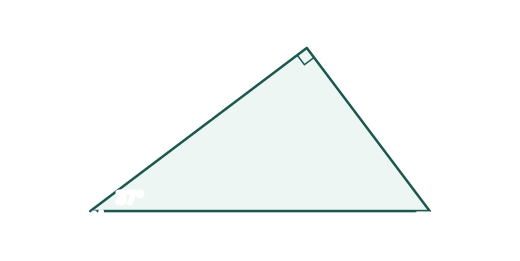
Known measurements and unknowns are labeled. Equal scale on both axes. - A ladder makes a \(63^\circ\) angle with the ground. Its foot is \(11\) feet from the wall. Find its length.
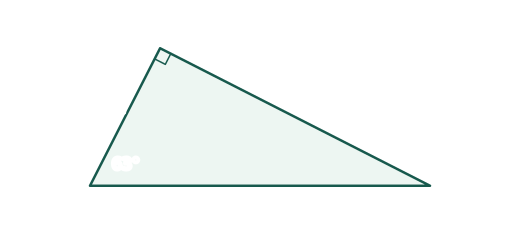
Known measurements and unknowns are labeled. Equal scale on both axes. - A \(25\)-foot pole casts a shadow. The angle from the shadow tip to the pole top is \(32.48^\circ\). Find the shadow length.
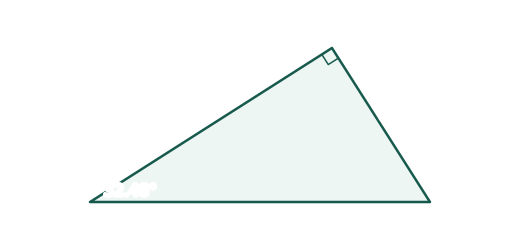
Known measurements and unknowns are labeled. Equal scale on both axes. - Ben supports a \(40\)-centimeter tower with a wire making \(58^\circ\) with the ground. Find the wire length.
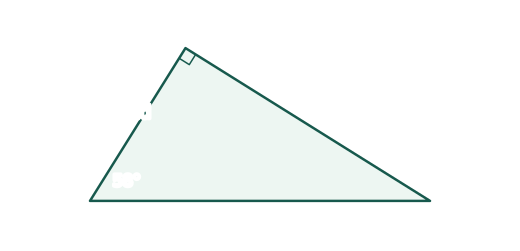
Known measurements and unknowns are labeled. Equal scale on both axes. - A ladder makes \(50^\circ\) with the ground, with its foot \(2\) meters from a wall. Find its length.
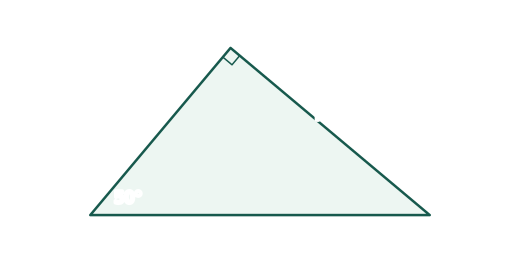
Known measurements and unknowns are labeled. Equal scale on both axes. - A \(75\)-foot guy wire runs from the top of a \(45\)-foot pole to the ground. Find its angle with the ground.
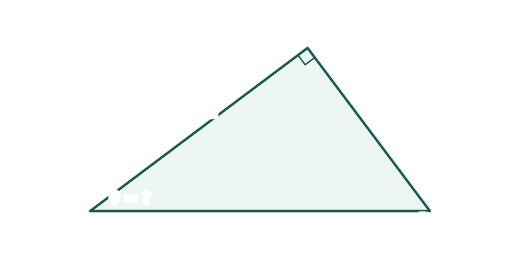
Known measurements and unknowns are labeled. Equal scale on both axes. - A stretched \(120\)-centimeter string connects a nail \(80\) centimeters above the ground to a brick on the ground. Find its angle with the ground.
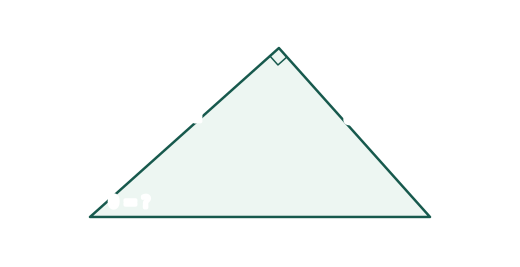
Known measurements and unknowns are labeled. Equal scale on both axes.
Show worked solution
- The height is opposite the angle: \(h/120=\tan37^\circ\), so \(h\approx90.43\) feet.
- The ladder is the hypotenuse: \(11/L=\cos63^\circ\), so \(L\approx24.23\) feet.
- \(25/s=\tan32.48^\circ\), so \(s\approx39.27\) feet.
- \(40/L=\sin58^\circ\), so \(L\approx47.17\) centimeters.
- \(L=2/\cos50^\circ\approx3.11\) meters.
- \(\theta=\arcsin(45/75)\approx36.87^\circ\).
- \(\theta=\arcsin(80/120)\approx41.81^\circ\).
A reliable solving routine
- Sketch and label the right angle.
- Choose the acute reference angle and label its opposite and adjacent legs.
- Use Pythagoras for missing sides when two sides are known.
- Select a trigonometric ratio; rearrange before calculating.
- Use inverse ratios for angles and degree mode for these examples.
- Check dimensions, angle sums, and whether the answer is plausible.
Use ratios to test and interpret models
A trigonometric ratio describes the shape of a right triangle; a length sets its scale. Before calculating, identify the reference angle and decide which measurements the model actually determines.
Reasoning · Can a ratio determine a height?
Two ramps each make an acute angle \(A\) with level ground, with \(\tan A=3/4\). A student says both ramps must rise \(3\) metres. Is that justified? Describe every possible pair of rise and horizontal run, and determine the rise if the sloping length is \(10\) metres.
Hint
Equivalent ratios can come from different lengths. Use a scale factor and the Pythagorean theorem.
Show worked solution
All positive rises and runs with this ratio have the form \(3s,4s\), where \(s>0\) metres. Their sloping lengths are \(\sqrt{9s^2+16s^2}=5s\). The angle fixes the ratio, not \(s\), so the claimed height is unjustified. If \(5s=10\), then \(s=2\): rise \(6\) m and run \(8\) m.
Multi-step · Two observations of a tower
On level ground, an observer sees the top of a vertical tower at elevation \(30^\circ\). After walking \(20\) m directly toward its base, the angle is \(60^\circ\). The observer's eyes stay \(1.5\) m above ground. Find the tower's height.
Hint
Let the nearer horizontal distance be x. Both right triangles share the same height above eye level.
Show worked solution
Therefore \(h=1.5+10\sqrt3\approx18.82\) m. Both observations measure the height above the eyes, so adding eye height is necessary. The farther distance is \(30\) m; substituting it into the first observation gives the same height.
Advanced / Honors · Prove the complementary relationship
In a right triangle, the acute angles are \(A\) and \(B\). Prove \(\sin A=\cos B\) and \(\tan A\tan B=1\) from the side definitions. Explain the restrictions on these claims.
Hint
Name the legs a and b opposite A and B, and use the same hypotenuse c.
Show worked solution
The two legs are positive and nonzero, making both tangent ratios defined. Also \(A+B=90^\circ\), because the third angle is a right angle. These arguments concern complementary acute angles of a nondegenerate right triangle; they do not assert these equalities for arbitrary pairs of angles.