Symmetries & Tilings
Identify isometries, finite symmetry groups, and the structure of repeating plane patterns.
Learning goals
- Distinguish an isometry from a symmetry of an object.
- Identify cyclic and dihedral symmetry.
- Analyze tilings and distinguish wallpaper groups using rotations, mirrors, and glides.
Geometry in patterns
A pattern is more than a collection of attractive shapes: it contains repeated relationships. We will ask which motions leave a design unchanged and how its pieces cover the plane. Those questions connect the appearance of a motif to the structure of its symmetries.
Repeated patterns occur in honeycombs, architecture, manufactured tiles, and woven textiles. Examples include the Alhambra and T’boli t’nalak. A mathematical description concerns visible geometric structure; it does not replace the cultural meaning of a design.
Tess’s tiled form invites the same questions: what repeats, which motions preserve the pattern, and which details break a symmetry?
Isometries and symmetries
Imagine tracing a figure and moving the tracing without changing its size or shape. Such a motion preserves distance. It is a symmetry of the figure only when the moved tracing fits the original exactly. Keep those two questions separate: what kind of motion is it, and does this particular figure remain unchanged?
An isometry preserves distances. A symmetry of an object is an isometry that sends the entire object onto itself, including any colors or markings that are part of its design.
| Isometry | Action |
|---|---|
| Translation | Move every point by the same vector |
| Rotation | Turn about a fixed center |
| Reflection | Flip across a line |
| Glide reflection | Reflect in a line and translate parallel to it |
A motion can preserve distances without being a symmetry of a particular figure. A marked vertex can destroy a symmetry of an otherwise regular polygon.
Predict which points stay fixed
Reflect the plane by (x, y) → (x, −y). Which points remain at exactly the same location? Predict first, then compare both coordinates.
Use composition to distinguish a glide from a mirror
Reflecting in the horizontal axis and translating parallel to it by a nonzero amount a gives \(G(x,y)=(x+a,-y)\). Applying G twice yields \(G^2(x,y)=(x+2a,y)\): a translation, not the identity. A reflection alone squares to the identity and fixes its mirror line. A genuine glide has no fixed point because \(x+a=x\) would require \(a=0\). This gives a practical check when a repeating motif looks reflected but also displaced.
Follow a footprint
A pattern is preserved by \(G(x,y)=(x+3,-y)\). Starting at \((1,2)\), find the next three images. Explain why seeing a reflection in each step does not make G a reflection.
Show worked solution
The images are \((4,-2),(7,2),(10,-2)\). After two steps the point has moved six units along the axis. A reflection would return it to its start after two applications; this motion does not.
Finite groups: cyclic and dihedral
Count motions, not visible pieces
The order of a finite symmetry group is its number of elements, including the identity. The order of a rotation is the smallest positive number of repetitions that gives the identity, when such a number exists.
Count motions that preserve the entire design, rather than its visible pieces. Adding reflection symmetries can increase the group order without increasing the order of its rotations.
Listing a few symmetries is a beginning, but we also need to understand how they combine. Performing one symmetry after another must leave the figure unchanged too. This is why the full collection has a group structure rather than being an unrelated list of motions.
For a finite design, \(C_n\) contains \(n\) rotations including the identity. \(D_n\) contains those rotations and \(n\) reflections, for \(2n\) symmetries. We use the convention that a regular n-gon has group \(D_n\).
\[\text{smallest positive rotation}=\frac{360^\circ}{n}\]A regular five-pointed star
Show worked solution
Its smallest positive rotation is \(72^\circ\) and it has five reflection axes. Its symmetry group is \(D_5\), of order ten.
A pinwheel
Show worked solution
Its group is \(C_4\), with four rotations and no reflections.
Test the labels as well as the outline
Symmetry depends on which features are declared part of the object. To count rotations of a colored polygon, check how many vertex steps return the entire ordered color pattern to itself. A rotation preserving the outline may still fail the color test.
Alternating colors on a hexagon
The six vertices of a regular hexagon alternate red and blue. How many rotations, including the identity, preserve the colored figure? What is the smallest positive one?
Show worked solution
A one-vertex turn of \(60^\circ\) swaps the colors and fails. An even number of vertex steps preserves every color. Allowed steps are \(0,2,4\), giving three rotations and a smallest positive angle of \(120^\circ\). Do not count a full turn again as a new transformation.
This argument counts rotations only. A full symmetry-group classification must test reflections separately; the number of rotations alone does not establish whether the group is cyclic or dihedral.
Reflections and typography
A familiar letter can look symmetric at first glance, but the exact drawn shape is what matters. Compare corresponding parts across the proposed mirror line. Font details may destroy a symmetry that a simplified block letter has, so justify your answer from the displayed figure.
A shape with only one reflection has group D₁; a nonsquare rectangle has D₂. Letter symmetries depend on the actual typeface: do not infer them from the letter name alone.
Rectangle or square?
Show worked solution
A nonsquare rectangle has two mirror axes and a half-turn, hence D₂. A square adds quarter-turns and diagonal mirrors, hence D₄. The identity is counted in both groups.
Tilings and translations
A finite figure has an edge, while a repeating tiling continues across the plane. That changes the motions we should look for. Begin by finding a repeating piece and the translations that carry it to its neighbors.
A tiling covers the plane with tiles, leaving no gaps or overlaps of interiors. A wallpaper pattern repeats by translations in two nonparallel directions. Its symmetry group contains every isometry preserving the full infinite pattern.
Regular polygons around a vertex
Show worked solution
No whole number of these angles fills one turn. Regular triangles, squares, and hexagons do pass this test and tile the plane.
A finite drawing shows a window into a pattern. Ignore the window boundary when analyzing the ideal infinite tiling.
The seventeen wallpaper groups
What the classification describes
A wallpaper group is a discrete group of Euclidean plane isometries whose translations form a lattice generated by two independent vectors.
The names identify arrangements of translations, rotations, reflections and glides, not particular tile shapes or artistic styles. Different-looking patterns can therefore have the same group.
Translations tell us that a pattern repeats; they do not yet identify all its symmetries. Now inspect the entire repeating design for reflections, rotations, and glide reflections. A symmetry of one tile may fail for the full arrangement. Use the whole pattern as your evidence when deciding which group describes it.
First find the largest rotation order. For a periodic plane pattern it can be one, two, three, four, or six. Then inspect mirrors, their intersections, rotation centers, and essential glide reflections. A color change can reduce the group.
| Group | Distinguishing features | Orbifold notation |
|---|---|---|
| \(\mathrm{p1}\) | No nonidentity rotations or mirrors | \(\text{o}\) |
| \(\mathrm{pg}\) | Glides; no mirrors or rotations | \(\text{××}\) |
| \(\mathrm{pm}\) | Parallel mirrors; no essential glide between them | \(\text{**}\) |
| \(\mathrm{cm}\) | Parallel mirrors with intervening glides | \(\text{*×}\) |
| \(\mathrm{p2}\) | Half-turns, no mirrors or glides | \(\text{2222}\) |
| \(\mathrm{pgg}\) | Half-turns and glides, no mirrors | \(\text{22×}\) |
| \(\mathrm{pmg}\) | Half-turns; mirrors in one direction | \(\text{22*}\) |
| \(\mathrm{pmm}\) | Perpendicular mirrors; all half-turn centers on mirrors | \(\text{*2222}\) |
| \(\mathrm{cmm}\) | Perpendicular mirrors; some half-turn centers off mirrors | \(\text{2*22}\) |
| \(\mathrm{p3}\) | Threefold rotations, no mirrors | \(\text{333}\) |
| \(\mathrm{p3m1}\) | Threefold rotations; all centers on mirrors | \(\text{*333}\) |
| \(\mathrm{p31m}\) | Threefold rotations; some centers off mirrors | \(\text{3*3}\) |
| \(\mathrm{p4}\) | Fourfold rotations, no mirrors | \(\text{442}\) |
| \(\mathrm{p4m}\) | Fourfold rotations; mirrors intersect at 45 degrees | \(\text{*442}\) |
| \(\mathrm{p4g}\) | Fourfold rotations; no mirror through a fourfold center | \(\text{4*2}\) |
| \(\mathrm{p6}\) | Sixfold rotations, no mirrors | \(\text{632}\) |
| \(\mathrm{p6m}\) | Sixfold rotations with mirrors | \(\text{*632}\) |
“No glides” in the classification means no additional essential glides beyond combinations already implied by translations and mirrors. Use the complete pattern, not a single motif.
A classification route
A busy pattern can make every symmetry seem plausible. Use a consistent order of checks instead: translations, rotation centers, reflections, then glide reflections. Each confirmed feature narrows the possibilities, and a feature that is absent can be just as informative.
- No rotations: check mirrors, then glides; distinguish p1, pg, pm, cm.
- Half-turns: check mirrors in zero, one, or two directions and whether all centers lie on mirrors.
- Threefold: no mirrors gives p3; with mirrors, inspect whether every threefold center lies on a mirror.
- Fourfold: no mirrors gives p4; mirror placement distinguishes p4m from p4g.
- Sixfold: absence or presence of mirrors distinguishes p6 from p6m.
Square lattice
Show worked solution
There are quarter-turn centers and mirrors meeting at forty-five degrees. The wallpaper group is p4m.
A chiral repeating motif
Show worked solution
The group is p1. Translation symmetry does not imply reflection symmetry.
Practice and explanations
Group order
Show worked solution
Six rotations including identity, and six reflections.
Smallest turn
Show worked solution
Detect a glide
Show worked solution
A glide reflection. The translation must be parallel to the reflection axis.
The role of color
Show worked solution
No. A nontrivial rotation moves the unique color to a different position. Symmetry must preserve the marked design as well as its outline.
Additional practice: mixed exercises
Symmetry in capital letters
Use ideal block capitals with matching halves, not the accidental asymmetry of a particular font. Describe the reflection axes and rotations.
- Which ideal capitals have exactly one reflection axis?
- Classify ideal H, I, a noncircular oval O, and an X whose horizontal and vertical spans differ.
Show worked solution
- A, M, T, U, V, W, Y have a vertical axis; B, C, D, E, K can have a horizontal axis when their upper and lower halves match. These have group \(D_1\): identity and one reflection.
- Each has horizontal and vertical reflection axes and a half-turn: group \(D_2\). A perfectly circular O has infinitely many axes; a specially proportioned X can have more symmetry, so the drawn shape matters.
Finite designs and idealization
Classify the specified ideal design, including its markings. Natural objects and photographs usually have only approximate symmetry.
- Four identical heart-shaped leaves meet at a common center, equally spaced and pointing outward. Identify the group and mirror axes.
- A four-bladed pinwheel has four identical curved blades, all bending in the same rotational direction. Identify its group.
- Does a black-and-white yin–yang design have half-turn symmetry if black and white must be preserved?
- An idealized front-facing cat face has matching left and right halves but no other symmetry. Identify its group.
- An ideal starfish has five identical arms evenly spaced about its center, each symmetric about its radial line. Identify its group.
- An ideal snowflake has six identical evenly spaced branches, each mirror-symmetric about its radial line. Identify its group.
Show worked solution
- The ideal four-leaf design has \(D_4\) symmetry: rotations by multiples of \(90^\circ\) and four mirror axes through opposite leaves or gaps. Actual leaf veins can break these exact symmetries.
- Its group is \(C_4\). Rotations by \(90^\circ,180^\circ,270^\circ\) preserve it, as does the identity. Reflection reverses the handedness, so there are no mirror axes.
- No. A half-turn exchanges black and white. The usual colored design has only the identity, \(C_1\). A half-turn can be called a color-exchanging symmetry only if that extra convention is explicitly permitted.
- One vertical reflection axis gives \(D_1\), with two symmetries: identity and reflection. No nontrivial rotation preserves the face.
- \(D_5\): five rotations including identity, in steps of \(72^\circ\), and five radial reflection axes. The rotation center is where the arms meet.
- \(D_6\): six rotations in steps of \(60^\circ\) and six reflection axes through the center. It has \(12\) symmetries altogether.
Enlarge pattern 1 →
Enlarge pattern 2 →
Enlarge pattern 3 →
Enlarge pattern 4 →
Enlarge pattern 5 →
Enlarge pattern 6 →
Classify illustrated patterns
Use the numbered patterns below. Treat each as an ideal infinite repeat, ignoring the cropped boundary and photographic imperfections. Identify its wallpaper group and the features supporting it.
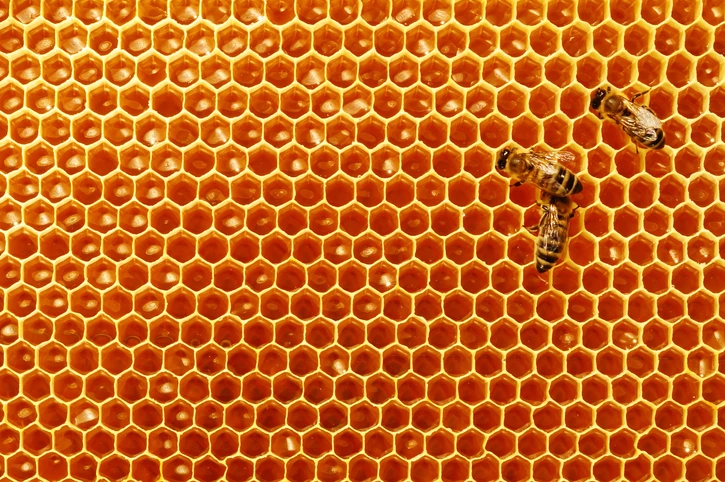
- Pattern 1: honeycomb.
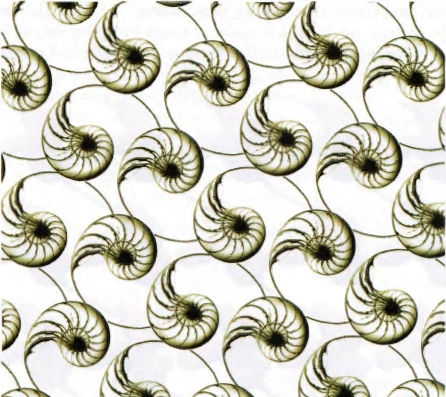
- Pattern 2: alternating shells.
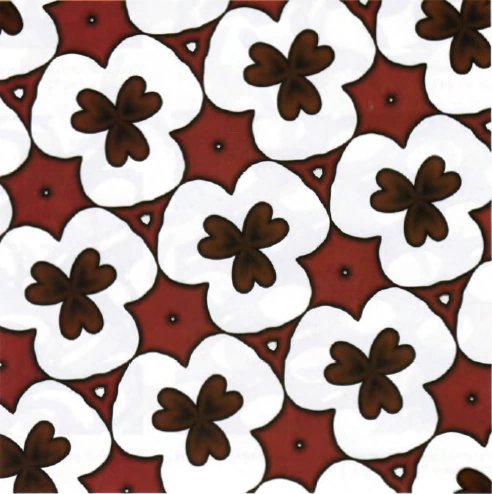
- Pattern 3: threefold floral design.
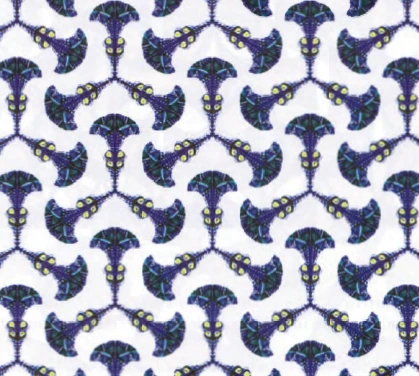
- Pattern 4: triangular motif repeat.
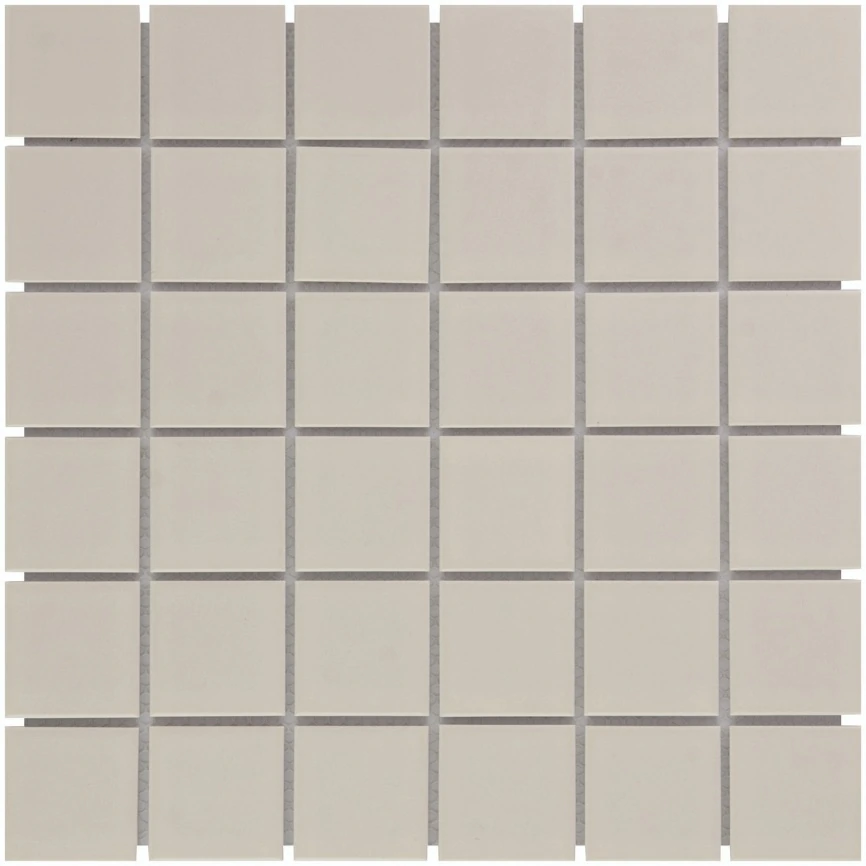
- Pattern 5: ideal square grid.
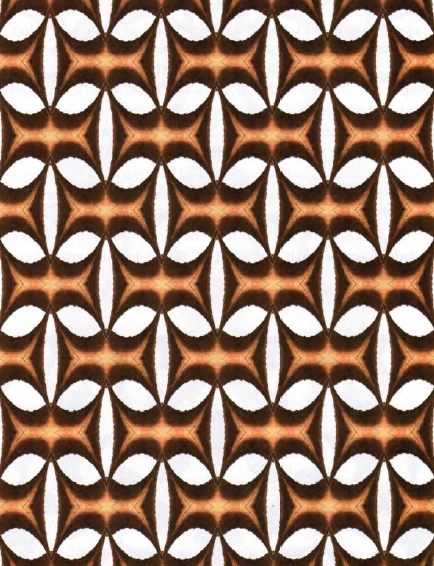
- Pattern 6: oval lattice.
Show worked solution
- \(\mathrm{p6m}\). The ideal regular hexagonal pattern has sixfold rotations and reflection axes.
- \(\mathrm{pg}\). Translations and glide reflections preserve the repeat; there are no pure reflection axes or nontrivial rotation centers.
- \(\mathrm{p3m1}\). Threefold rotations and mirrors occur, with the threefold centers on mirror axes.
- \(\mathrm{p31m}\). Threefold rotation centers occur both on and off mirrors, distinguishing it from \(\mathrm{p3m1}\).
- \(\mathrm{p4m}\). Quarter-turns and mirrors along the grid and its diagonals preserve the pattern.
- \(\mathrm{cmm}\). Two perpendicular families of mirrors and half-turn centers form a centered rectangular pattern; some half-turn centers lie off the mirrors.

Enlarge pattern 7 →
Enlarge pattern 8 →
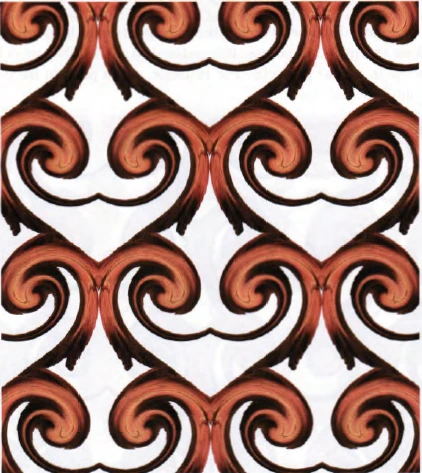
Enlarge pattern 9 →
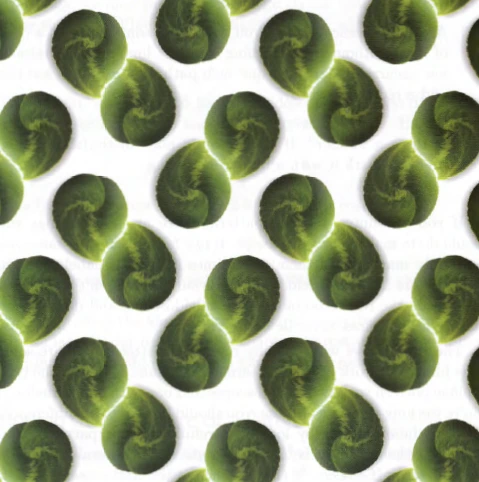
Enlarge pattern 10 →
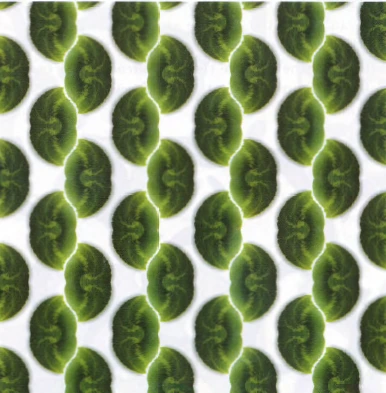
Enlarge pattern 11 →
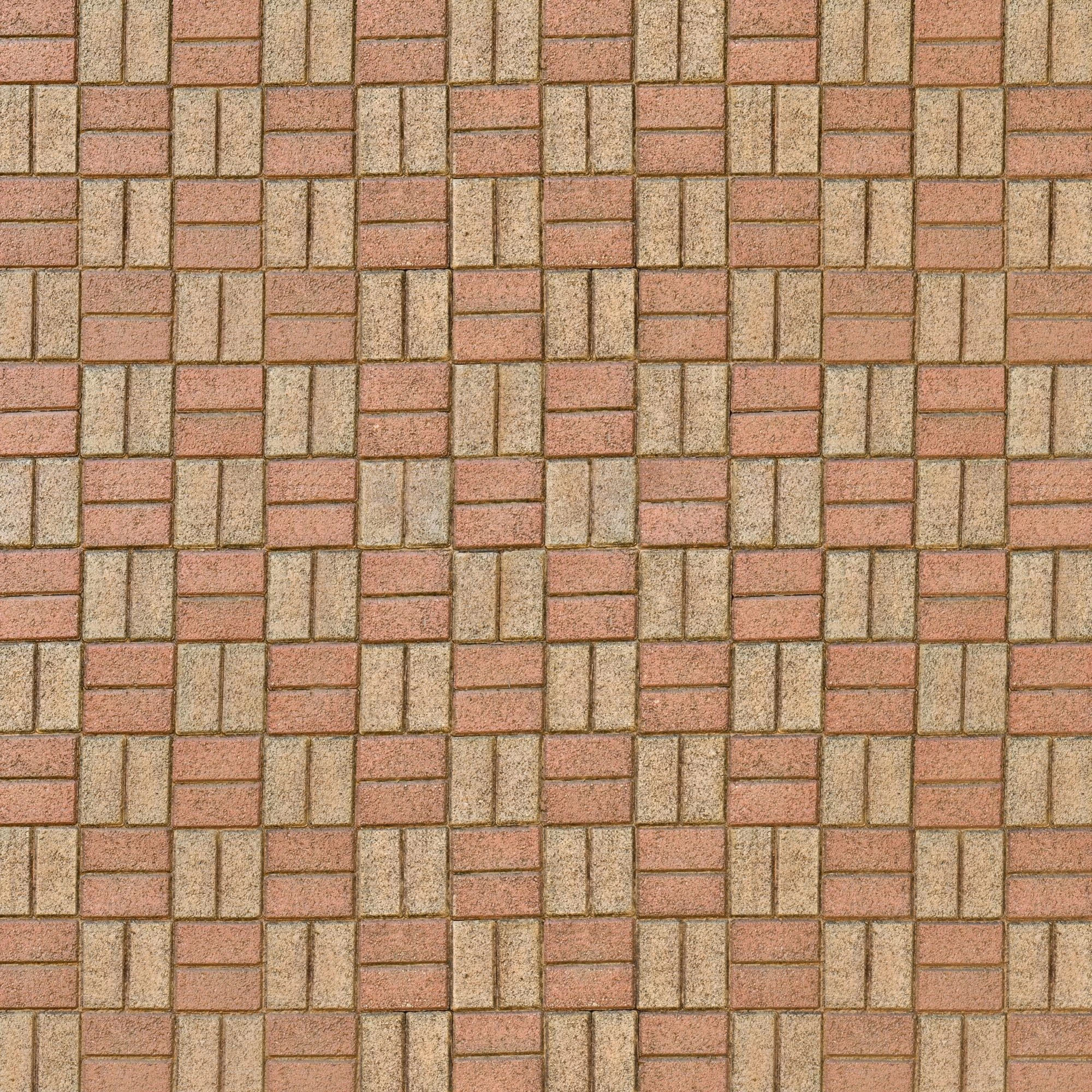
Enlarge pattern 12 →
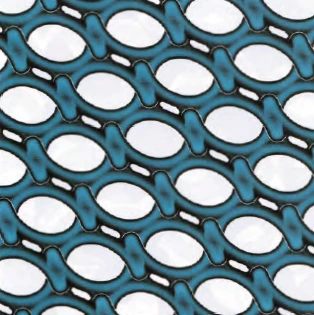
Enlarge pattern 13 →
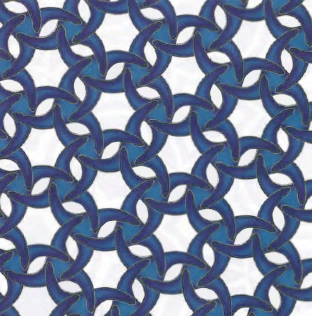
Enlarge pattern 14 →
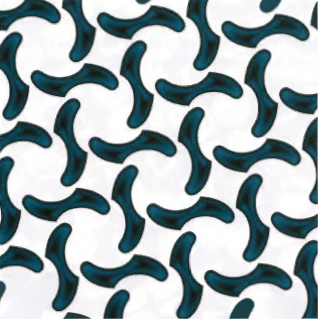
Enlarge pattern 15 →
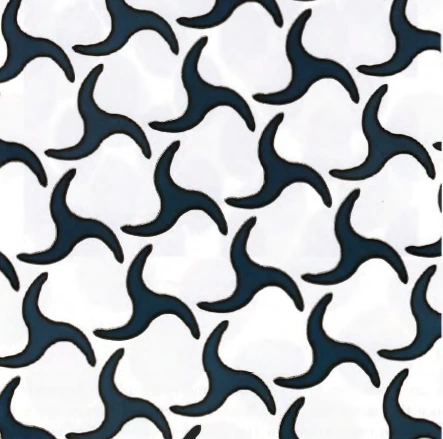
Enlarge pattern 16 →
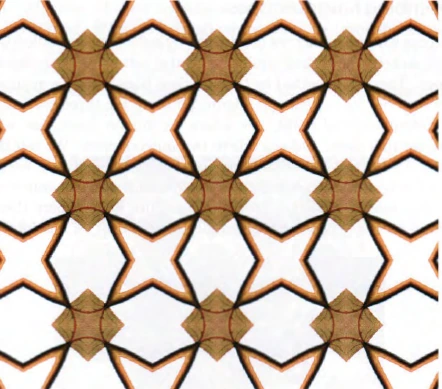
Enlarge pattern 17 →

Enlarge pattern 18 →
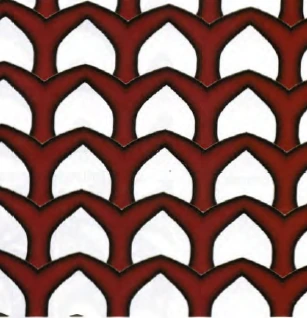
Enlarge pattern 19 →
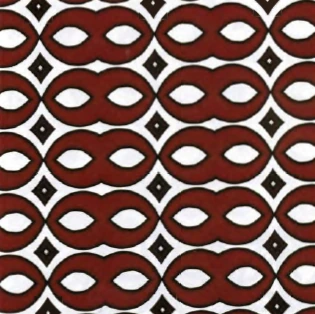
Enlarge pattern 20 →
More illustrated patterns
Use patterns 7–20 below. Treat the designs as ideal infinite repeats, ignoring the photograph boundary and small imperfections.
- Pattern 7: rectangular brick grid.
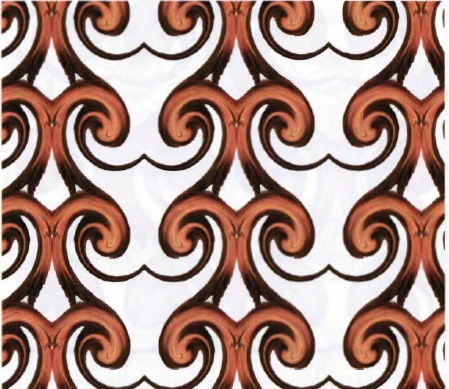
- Pattern 8: aligned scrolls.
- Pattern 9: staggered scrolls.
- Pattern 10: alternating shell directions.
- Pattern 11: paired shell columns.
- Pattern 12: basket-weave paving.
- Pattern 13: blue oval repeat.
- Pattern 14: blue pinwheels.
- Pattern 15: four-armed pinwheels.
- Pattern 16: three-armed pinwheels.
- Pattern 17: star lattice.
- Pattern 18: repeated pink motif.
- Pattern 19: red arches.
- Pattern 20: red loops.
Show worked solution
- \(\mathrm{pmm}\). Horizontal and vertical mirrors intersect at half-turn centers. Rectangular bricks do not have quarter-turn symmetry.
- \(\mathrm{pm}\). One parallel family of mirrors preserves the scrolls; turning them upside down does not.
- \(\mathrm{cm}\). Parallel mirrors occur in a centered rectangular repeat, with glide reflections between them.
- \(\mathrm{pgg}\). Half-turns and perpendicular glide reflections preserve the pattern, but pure reflections do not.
- \(\mathrm{pmg}\). Half-turns, parallel mirrors, and perpendicular glides preserve the design.
- \(\mathrm{p4g}\). Quarter-turns and glide reflections occur; the fourfold centers are not on mirror axes.
- \(\mathrm{p2}\). Half-turns preserve the repeat. Mirrors and higher-order rotations do not.
- \(\mathrm{p6}\). Sixfold rotations preserve the repeat; a reflection reverses the pinwheels, so there are no mirrors.
- \(\mathrm{p4}\). Quarter-turns preserve the design, but reflections reverse its handedness.
- \(\mathrm{p3}\). Third-turns preserve the design; there are no reflection axes.
- \(\mathrm{p4m}\). Quarter-turns and mirrors through the fourfold centers preserve the ideal design.
- \(\mathrm{p1}\). Translations preserve the design; its oriented motif rules out nontrivial rotations, mirrors, and glides.
- \(\mathrm{pm}\). Vertical mirrors preserve the arches. Horizontal reflection or a half-turn reverses their orientation.
- \(\mathrm{pmm}\). Horizontal and vertical mirrors and half-turns preserve the loops; quarter-turns do not.
Summary
- Test the complete object, including colors and markings.
- Distinguish finite symmetry from infinite wallpaper symmetry.
- Rotation order and mirror placement guide classification.
Reasoning, connections and deeper practice
A symmetry must preserve the full design. These problems connect local angle conditions, global tilings and the effect of markings. A necessary local condition must be followed by an actual construction or a global argument.
Reasoning · A marking changes the group
Color one vertex of a regular hexagon red and leave its other vertices unmarked. Determine every symmetry of the marked figure. Explain which symmetries of the unmarked hexagon survive.
Hint
Every surviving motion must fix the unique red vertex.
Show worked solution
Only the identity rotation fixes that vertex. Among the six reflection axes, exactly the line through the red vertex and its opposite vertex fixes it; the other five move it. Thus two symmetries survive: identity and that reflection, giving \(D_1\) under the lesson's convention. The unmarked outline alone would have \(D_6\), with twelve symmetries.
Advanced / Honors · Classify regular edge-to-edge tilings
Suppose congruent regular n-gons tile the plane edge-to-edge with m polygons meeting at every vertex. Prove that the only possible pairs are \((n,m)=(3,6),(4,4),(6,3)\), and explain why each possibility really occurs.
Hint
The interior angle is \((n-2)\pi/n\). Set m copies equal to a full turn and rearrange into an integer product.
Show worked solution
The angle condition is \(m(n-2)=2n\), which rearranges to \((m-2)(n-2)=4\). Both factors are positive integers because \(m,n\ge3\). The factor pairs \((1,4),(2,2),(4,1)\) give exactly the three stated possibilities. Equilateral triangles form a triangular grid, squares form a square grid, and regular hexagons form the honeycomb tiling, so all three necessary possibilities are realized. This does not rule out tilings by irregular pentagons or mixtures of different regular polygons.
Reference and further reading
Conway, J. H., Burgiel, H., & Goodman-Strauss, C. (2008). The Symmetries of Things. A K Peters. ISBN 978-1-56881-220-5. Publisher information.
Further reading on symmetry and the classification of patterns. The numbered practice illustrations are extracted from the supplied Module 5: Symmetries teaching slides; their inclusion here does not attribute every illustration to this book.