Simple and Compound Interest
Model saving and borrowing, compare simple and compound growth, and plan for future prices.
Principal, interest and time
A savings deposit gives someone else the use of your money. A loan gives you the use of someone else’s money. Interest measures the cost or reward for that use over time. Before calculating, identify whose money is growing, the rate’s time unit, and whether interest itself earns interest.
The quantities
\(P\) is the initial principal; \(I\) is the interest; \(A=P+I\) is the accumulated or maturity value. An annual rate \(r\) is written as a decimal: 5% becomes 0.05. Time \(t\) is measured in years when the rate is annual.
| Quantity | Meaning | Example |
|---|---|---|
| P | Initial amount | ₱5,000 |
| r | Annual decimal rate | 3% = 0.03 |
| t | Elapsed years | January 2016 to January 2021: 5 |
| I | Interest only | Excludes the original deposit |
| A | Principal plus interest | Total at maturity |
Separate the quantities
An investment grows from ₱8,000 to ₱9,240. What are \(P\), \(I\) and \(A\)?
Hint
The increase is interest; the final balance includes principal.
Show worked solution
P = ₱8,000, A = ₱9,240 and I = 9,240 − 8,000 = ₱1,240.
Simple interest
Interest on the original principal
\(I=Prt\). Each year adds the same amount \(Pr\) when principal and rate stay fixed. Interest is not added to the base used for the next interest calculation.
A five-year deposit
Show worked solution
Interest is ₱750. The maturity value is A = 5,000 + 750 = ₱5,750. A quick check: 3% of ₱5,000 is ₱150 per year; five equal additions give ₱750.
Planning for retirement
Show worked solution
The investment lasts 60 − 25 = 35 years. There are no later deposits in this model.
\[I=30000(0.05)(35)=52500,\qquad A=82500\]The fund contains ₱82,500. This is a nominal amount; it does not yet account for changing prices.
Susan and James
Susan deposits ₱2,000 at 7% annual simple interest for six years. James deposits ₱10,000 at 2.5% for two years. Find each maturity value.
Hint
Use A = P(1 + rt), not just Prt.
Show worked solution
Susan: A = 2,000(1 + 0.07 × 6) = ₱2,840. James: A = 10,000(1 + 0.025 × 2) = ₱10,500. Their interest amounts are ₱840 and ₱500.
Months, days and day-count conventions
A rate and a time must use compatible units. Nine months is 9/12 of a year, not nine years. For days, the agreement must identify a year basis. We distinguish exact simple interest using days/365 from ordinary simple interest using days/360. Count actual elapsed days unless a different date-count convention is explicitly stated.
\[t=\frac{m}{12},\qquad t_{\mathrm{exact}}=\frac{d}{365},\qquad t_{\mathrm{ordinary}}=\frac{d}{360}\]One deposit, two time units
Show worked solution
The 360-day basis gives slightly more interest for the same actual days because it uses a larger fraction of a year.
Two maturity dates
Find maturity values for an ₱8,000 loan at 9.75% annual simple interest for eight months and for five years.
Hint
Convert eight months to 8/12 year before multiplying.
Show worked solution
Eight months: I = 8,000(0.0975)(8/12) = ₱520, so A = ₱8,520. Five years: I = ₱3,900, so A = ₱11,900.
Common mistake: multiplying an annual rate by a number of months overstates the interest twelvefold. A day basis is a convention, not a statement that every calendar year contains 360 days.
Finding principal, rate or time
Financial planning often starts with a target rather than a deposit. Rearrange the model before inserting numbers. The formula changes with the unknown, but the meaning of each symbol stays the same.
\[P=\frac{A}{1+rt},\qquad r=\frac{A-P}{Pt},\qquad t=\frac{A-P}{Pr}\]Recover the initial investment
Show worked solution
About ₱20,161.29 was invested. Dividing by rt alone would recover principal from interest, not from the maturity value.
A short loan and a savings target
A ₱4,000 three-month loan matures at ₱4,085. Find its annual simple rate. Then find the deposit needed for $1,424.50 after six months at 3.5% annual simple interest.
Hint
For the rate use the interest 4,085 − 4,000. For the deposit use the full target.
Show worked solution
The required deposit is $1,400.
Compound interest and periods
Interest earns interest
With nominal annual rate \(r\) compounded \(n\) times per year, the periodic rate is \(r/n\) and the number of periods is \(nt\). Each period multiplies the balance by \(1+r/n\).
| Compounding | n per year | Periods in 3 years |
|---|---|---|
| Annually | 1 | 3 |
| Semiannually | 2 | 6 |
| Quarterly | 4 | 12 |
| Monthly | 12 | 36 |
| Daily | 360 or 365, as stated | 3n |
Quarterly compounding
Show worked solution
There are four periods per year and eight periods in total. The rate per quarter is 0.03/4 = 0.0075.
\[A=5000(1.0075)^8\approx5307.99\]Using full precision, A = ₱5,307.99 and I = ₱307.99. Keep extra digits until the final currency rounding.
Monthly and semiannual growth
Find amount and interest for ₱6,000 at 2% compounded monthly for three years. Then find the amount for ₱10,000 at 8% compounded semiannually for four years.
Hint
Use 36 monthly periods and 8 half-year periods.
Show worked solution
First: A = 6,000(1 + 0.02/12)^36 = ₱6,370.70; I = ₱370.70. Second: A = 10,000(1.04)^8 = ₱13,685.69.
Common mistake: using r in every quarter charges the annual rate four times. Dividing r by n without multiplying t by n makes the opposite mismatch.
Comparing growth and effective rates
Simple interest grows by equal additions; compound interest grows by equal percentage multipliers. To compare two quoted compound rates fairly, convert both to the interest earned over the same full year.
\[r_{\mathrm{eff}}=\left(1+\frac rn\right)^n-1\]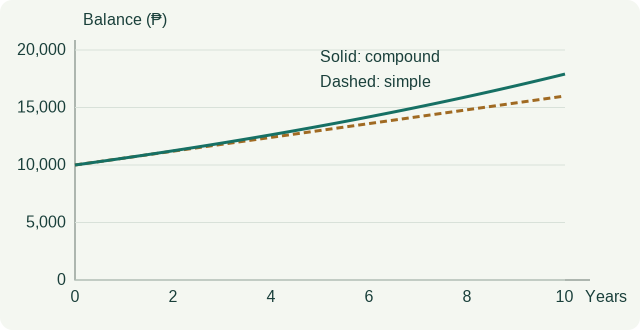
Which offer earns more?
Show worked solution
The second offer earns about 4.3182% effective annual interest, exceeding about 4.0742%. More frequent compounding does not automatically overcome a lower nominal rate.
Interpret a quoted yield
A savings rate is 3% compounded monthly. Find its effective annual rate to four decimal places as a percent.
Hint
Calculate one full year of growth on a principal of 1.
Show worked solution
100[(1 + 0.03/12)^12 − 1] = 3.0416%. About 3.04% is a rounded yield, not a separate monthly rate.
Present value and planning
Working backward through compound growth means dividing by the entire accumulation factor. This is useful for a target purchase, tuition fund or future payment when there are no intermediate deposits or withdrawals.
\[P=\frac{A}{(1+r/n)^{nt}}\]A five-year target
Show worked solution
P = ₱296,548.88. The deposit is below the target because future interest supplies the difference.
Three savings and borrowing decisions
Find (a) the five-year amount of ₱12,000 at 3.8% compounded semiannually; (b) the debt after 36 months on ₱35,000 at 6.7% compounded quarterly with no payments; (c) the deposit needed for ₱10,000 in ten years at 9.5% compounded annually.
Hint
Use years 5, 3 and 10; part (c) reverses growth.
Show worked solution
(a) ₱14,485.15. (b) ₱42,720.69. (c) ₱4,035.14. These models exclude fees, taxes and interim payments.
Inflation and purchasing power
Constant inflation model
If prices rise at a constant annual rate \(i\), an item costing \(C\) now costs \(C(1+i)^t\) after \(t\) years. This is a model assumption, not a prediction that actual inflation stays constant.
Salary and tuition targets
Show worked solution
Salary target = 28,000(1.06)^10 = ₱50,143.74 per month. Tuition target = 64,000(1.07)^18 = ₱216,315.67 per year.
The higher amounts buy approximately the same goods or education under the stated model; they do not represent an increase in real purchasing power.
A higher balance can buy less
Money grows 4% in one year while prices rise 6%. Find the percentage change in purchasing power.
Hint
Compare the growth factors 1.04 and 1.06, rather than subtracting the final cash amounts.
Show worked solution
Purchasing power falls about 1.89%. A positive money return can accompany a negative real return.
Explore and explain interest
Change principal, annual rate and time in the explorer. Predict which balance will be larger before calculating. Compare the table with the graph and explain where interest on interest begins to matter.
Find the mistake: a plausible shortcut
A student says: “At 6% compounded quarterly for three years, use P(1.06)^3. The word quarterly only changes the dates.” Identify and repair the error.
Hint
A compounding period determines both the rate and how many multipliers are applied.
Show worked solution
The shortcut uses annual compounding. Both expressions use 6% nominal annual rate, but they represent different agreements. Check by expanding the first year period by period.
Interactive exploration
References
R. N. Aufmann et al., Mathematical Excursions, 3rd ed.; R. L. Brown and S. Kopp, Mathematics of Finance, 8th ed. Further reading: OpenStax, Contemporary Mathematics, Money Management; Consumer Financial Protection Bureau, credit-card interest calculations and grace periods. These are mathematical models; actual agreements specify rates, fees, posting rules and grace-period eligibility.