Fundamental Trigonometric Identities
Use reciprocal, quotient, and Pythagorean identities to simplify and verify expressions.
Learning goals
- State the eight fundamental identities.
- Simplify expressions with algebra and common denominators.
- Keep the original domain when verifying an identity.
What an identity means
An equation may hold only for particular angles. An identity makes the stronger claim that both expressions agree wherever both are defined. A few calculator checks can suggest that claim, but cannot establish every case. Our task will be to explain why the agreement follows from known relationships.
An identity is an equality that holds for every value in the common domain of its two expressions.
A few numerical checks can suggest an identity but cannot prove it.
On the unit circle, cosine is the horizontal coordinate and sine is the vertical coordinate. This representation explains the identities that follow.
Reciprocal and quotient identities
The six ratios describe the same angle using different pairs of sides. Their shared origin gives us ways to rewrite one ratio in terms of others. We will use these relationships to simplify expressions, while keeping track of angles where a denominator would vanish.
\[\sec\theta=\frac1{\cos\theta},\quad\csc\theta=\frac1{\sin\theta},\quad\cot\theta=\frac1{\tan\theta}\]\[\tan\theta=\frac{\sin\theta}{\cos\theta},\qquad\cot\theta=\frac{\cos\theta}{\sin\theta}\]Every denominator must be nonzero. Reciprocal forms have the restrictions of both sides; use cosine/sine for cotangent when tangent itself is undefined.
Pythagorean identities
The reciprocal and quotient identities reorganize the ratios. The Pythagorean identities bring in a geometric relationship between them. Remembering that connection gives us a reason for the formulas instead of three unrelated statements to memorize.
\[\sin^2\theta+\cos^2\theta=1\]This is the unit-circle equation. Divide it by cosine squared or sine squared, where permitted, to obtain:
\[1+\tan^2\theta=\sec^2\theta,\qquad1+\cot^2\theta=\csc^2\theta\]Derive one identity
Show worked solution
Recognize tangent squared, one, and secant squared respectively. Cosine must be nonzero.
Products and ratios
Simplifying preserves a value on its domain
To simplify an expression is to give a more useful equivalent form wherever the original is defined.
Rewriting trigonometric ratios in terms of sine and cosine often exposes common factors. Each cancellation must remove a factor from numerator and denominator, and must retain any original exclusions.
We now have several identities available, so choosing a useful one matters more than recalling all of them at once. Look at the expression you want to simplify: would rewriting in sine and cosine expose a cancellation, or would a Pythagorean identity combine terms? Try a change for a reason, and check whether it makes the expression easier to compare.
A reciprocal product
Simplify the product and state the restrictions inherited from the original expression.
\(\cot\theta\tan\theta\)Show worked solution
The original expression requires both sine and cosine to be nonzero.
Use a quotient
Rewrite the product as one trigonometric function. Keep the original domain.
\(\cos\theta\csc\theta\)Show worked solution
Recognize a difference
Simplify the ratio using a Pythagorean identity.
\(\frac{1-\cos^2\theta}{\cos^2\theta}\)Show worked solution
Explore an identity
Numerical agreement is a useful check on a proposed identity, especially for spotting a sign error. It is not a proof over all allowed inputs. Use the activity to form or test a conjecture, then return to the definitions and algebra to explain why the relationship holds.
Use identities to recover information and prove a bound
An identity can do more than shorten an expression. It can connect an unknown quantity to a known one or establish a bound for every angle. In either use, state the allowed domain first, then explain each algebraic step. A numerical experiment is useful for predicting a result, but a proof must cover every allowed input.
Recover ratios from a sum
For an angle with \(\cos x\ne0\), suppose \(\sec x+\tan x=3\). Find sine and cosine.
Show worked solution
The identity \((\sec x+\tan x)(\sec x-\tan x)=1\) gives \(\sec x-\tan x=1/3\). Adding and subtracting the two equations yields \(\sec x=5/3,\ \tan x=4/3\). Therefore \(\cos x=3/5\) and \(\sin x=\tan x/\sec x=4/5\). Check: \(5/3+4/3=3\) and both ratios satisfy the unit-circle equation.
Challenge: the largest possible square
Prove that \(0\le(\sin x+\cos x)^2\le2\) for every real x, and show that both bounds can occur.
Show worked solution
The lower bound holds because it is a square. For the upper bound, expand \((\sin x-\cos x)^2\ge0\) to obtain \(1-2\sin x\cos x\ge0\). Hence \((\sin x+\cos x)^2=1+2\sin x\cos x\le2\). At \(x=3\pi/4\) the sum is zero; at \(x=\pi/4\) its square is two. The bound is sharp. Simply bounding sine and cosine separately by one would give four, a valid but unattainable upper estimate.
Algebra still matters
An identity does not remove the usual rules of algebra. Factoring, common denominators, and domain restrictions still matter. When a simplification seems unexpectedly easy, check that you have not canceled terms across a sum or divided by something that could be zero.
Simplify a compound denominator
Simplify the expression by applying an identity to its numerator and denominator.
\(\frac{1-\sin^2x}{\sin^2x+\cos^2x}\)Show worked solution
Cancel a factor
Simplify the expression and retain all restrictions from its original denominator.
\(\frac{1-\cos^2x}{\sin^2x\cos^2x}\)Show worked solution
Retain the original exclusions where sine or cosine is zero.
Add with a common denominator
Combine the terms and express the result as a product of reciprocal trigonometric functions.
\(\cos x\csc x+\tan x\)Show worked solution
Practice: justify every step
Treat a proof as a sequence that another student could follow. Work from a known expression, justify each replacement, and keep track of where it is defined. Reaching the expected final line is not enough if an earlier step changed the meaning.
Simplify
Simplify the difference using a Pythagorean identity.
\(\sec^2x-\tan^2x\)Show worked solution
A factored expression
Expand the product and express the result as a squared trigonometric function.
\((1-\sin x)(1+\sin x)\)Show worked solution
Find the sign
Find cosine of the angle. Use the stated quadrant to select the correct sign.
\(\sin\theta=3/5,\quad\theta\text{ in Quadrant II}\)Show worked solution
Choose the negative root because cosine is negative in Quadrant II.
Identify the error
Show worked solution
No. At \(x=\pi/4\), the left side is \(1\) and the right side is \(\sqrt2\). A counterexample disproves it.
Additional practice: mixed exercises
Reciprocal ratios in a triangle
Use a right triangle with legs \(8,15\) and hypotenuse \(17\). Angle \(\alpha\) is opposite \(15\) and angle \(\beta\) is opposite \(8\).
- Find \(\csc\alpha,\sec\beta,\cot\beta\).
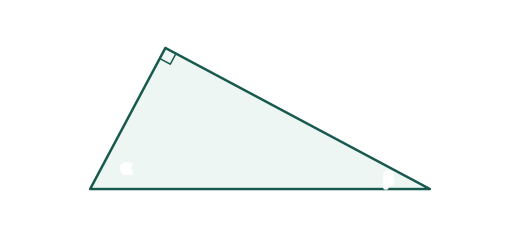
Known measurements and unknowns are labeled. Equal scale on both axes.
Show worked solution
- \(\sin\alpha=15/17\), so \(\csc\alpha=17/15\). Since the leg adjacent to \(\beta\) is \(15\), \(\sec\beta=17/15\). Finally \(\cot\beta=\text{adjacent}/\text{opposite}=15/8\).
Explain the domain
The slide simplifications are already worked in this lesson. For each one, state the exclusions that must still be retained after simplification.
- \(\cot x\tan x=1\)
- \(\cos x\csc x=\cot x\)
- \((1-\cos^2x)/(\sin^2x\cos^2x)=\sec^2x\)
Show worked solution
- Both \(\sin x\) and \(\cos x\) must be nonzero because the original factors contain both denominators.
- Require \(\sin x\ne0\); multiplication by cosine does not remove this restriction.
- Require \(\sin x\ne0\) and \(\cos x\ne0\). Cancellation cannot restore excluded inputs.
Takeaways and connections
- Rewrite in sine and cosine when useful.
- Use algebraic factorization and common denominators.
- Cancel factors, not separate terms; preserve domain restrictions.
Reasoning, connections and deeper practice
An identity is an equality on its stated domain, so simplifying and tracking exclusions belong to the same argument. The following tasks distinguish proof, equation solving and numerical evidence.
Reasoning · A cancellation keeps its exclusions
Simplify \((1-\cos^2x)/\sin x\), state its original real domain, and decide whether the simplified expression defines the same function on all real inputs.
Hint
Replace the numerator using the Pythagorean identity. Record the zero denominator before cancelling.
Show worked solution
The original expression requires \(\sin x\ne0\), so \(x\ne k\pi\) for integers \(k\). On that domain it is \(\sin^2x/\sin x=\sin x\). Sine itself is defined at the excluded inputs, so taking it on all real numbers extends the function rather than preserves the original domain. The formulas agree at every permitted original input.
Advanced / Honors · Turn a proposed identity into an equation
A student claims \(\sin x+\cos x=1\) is an identity because it works at \(0\) and \(\pi/2\). Disprove the identity and find all its real solutions without introducing extraneous answers.
Hint
Square the equation, use the Pythagorean identity, and then check every candidate in the unsquared equation.
Show worked solution
At \(x=\pi/4\), the left side is \(\sqrt2\), so the identity is false. Squaring a genuine solution gives \(1+2\sin x\cos x=1\), hence either \(\sin x=0\) or \(\cos x=0\). If \(x=k\pi\), the original equation requires \(\cos x=1\), yielding \(x=2k\pi\). If \(x=\pi/2+k\pi\), it requires \(\sin x=1\), yielding \(x=\pi/2+2k\pi\). Each of these satisfies the original equation. The candidates with sum \(-1\) are rejected after squaring.