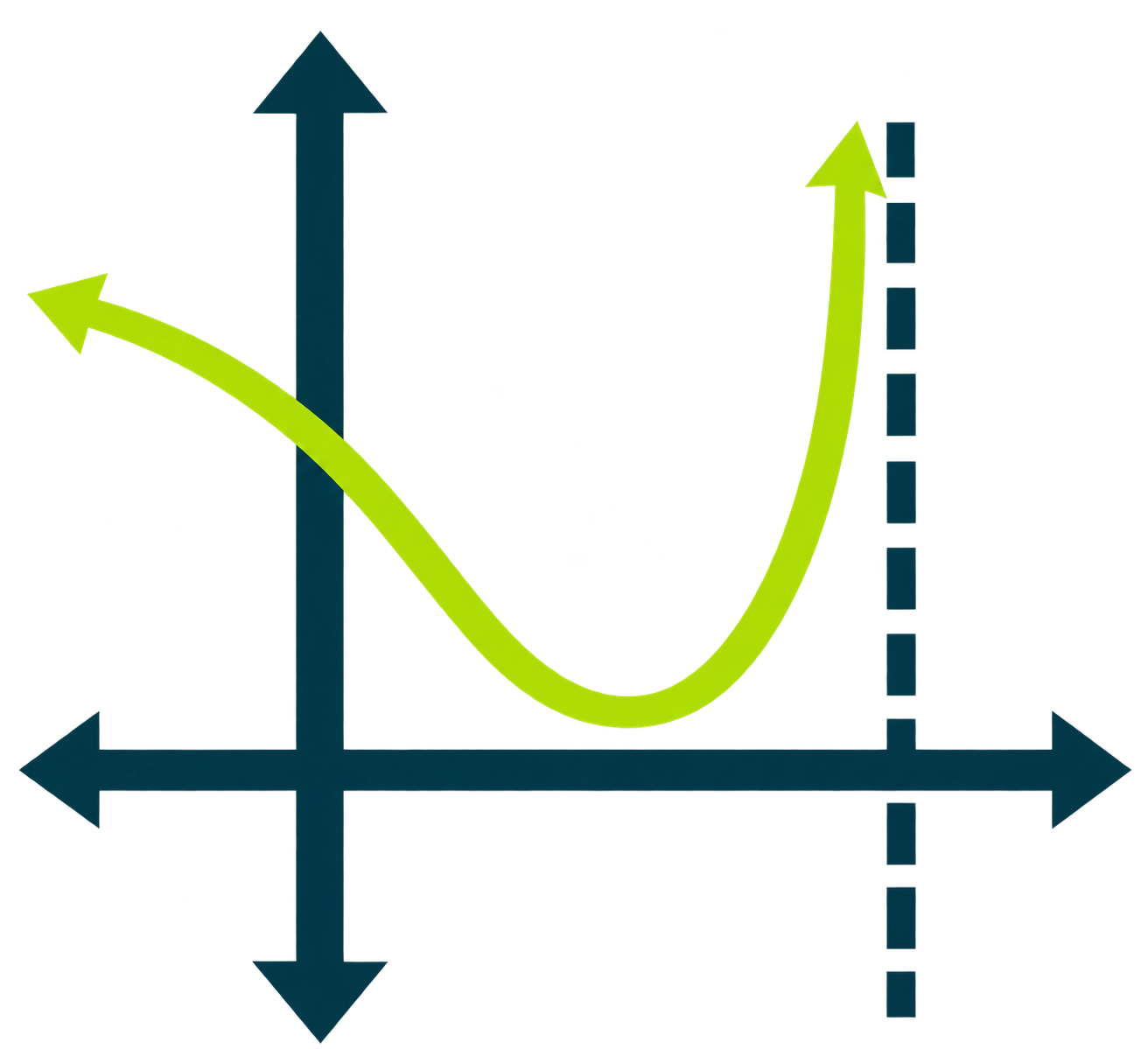
Exponential & Logarithmic Functions
Build from inverse functions to exponential and logarithmic graphs, equations, and models of growth and decay.
A route through the lesson
- Recognize one-to-one functions and find their inverses.
- Apply exponent laws and graph exponential functions.
- Interpret logarithms as exponents and use logarithm laws.
- Solve exponential and logarithmic equations with domain checks.
- Model compounding, growth, decay, and limiting behavior.
One-to-one functions and inverses
A function tells us how an input produces an output. To undo it, we need to recover the input from that output without ambiguity. Ask whether two different inputs could have produced the same value. This is the reason for checking one-to-one behavior before treating an inverse relation as a function.
An inverse undoes a function: \(f^{-1}(f(x))=x\) for inputs in the domain of \(f\). A function has an inverse function on its range when it is one-to-one. On a graph, every horizontal line must meet it at most once.
\(f^{-1}(x)\) denotes an inverse function, not \(1/f(x)\). A domain restriction can make a function one-to-one; it must be stated.
To find an inverse: check one-to-one behavior, write the rule with y, interchange x and y, solve for y, and state the inverse domain.
A linear inverse
Show worked solution
Both domains are all real numbers. Substitution into either composition gives the original input.
A radical inverse
Show worked solution
The original domain is \(x\ge2/5\) and range is \([3,\infty)\).
\[x=\sqrt{5y-2}+3\quad\Longrightarrow\quad(x-3)^2=5y-2\]\[g^{-1}(x)=\frac{(x-3)^2+2}{5},\qquad x\ge3\]The inverse domain comes from the original range; squaring does not remove that restriction.
Inverse graphs and rational rules
An inverse reverses the input–output relationship, so every point exchanges its coordinates. We will connect that exchange with reflection across the diagonal, then use algebra to recover an inverse rule. Domain and range must exchange roles as well.
The graph of an inverse is the reflection of the original graph across \(y=x\). Domain and range exchange roles. This geometric reflection requires equal coordinate-unit scaling.
A rational inverse
Show worked solution
The original domain excludes \(1\); its range excludes \(-2\). These restrictions swap for the inverse.
Why a domain restriction matters
Show worked solution
No. Two different inputs have the same output. The function is not one-to-one on the stated domain.
Exponent laws and real powers
To solve equations involving exponential growth, we first need to rewrite powers without changing their value. The exponent laws provide those legal moves; negative and fractional exponents extend their meaning to reciprocals and roots. Pay attention to the base restrictions before applying a rule.
For positive bases \(a,b\) and real exponents \(r,s\):
\[a^ra^s=a^{r+s},\quad\frac{a^r}{a^s}=a^{r-s},\quad(a^r)^s=a^{rs}\]\[(ab)^r=a^rb^r,\quad a^0=1,\quad a^{-r}=\frac1{a^r}\]For positive \(a\), \(a^{p/q}=\sqrt[q]{a^p}\). Irrational powers are defined consistently by limits of rational approximations.
Simplify negative powers
Show worked solution
Multiply each exponent by the outside exponent, then move the negative power to the denominator.
Exponential functions and transformations
The exponent laws tell us how to manipulate a rule. Now let us ask what that rule looks like as a function. Compare equal steps in the input: exponential change multiplies the output by a fixed factor, which is why its graph behaves differently from a straight line.
An exponential function has a variable in the exponent: \(f(x)=a^x\), with \(a>0\) and \(a\ne1\).
Its domain is all real numbers, its range is positive, its y-intercept is \((0,1)\), and its horizontal asymptote is \(y=0\).
The graph increases when \(a>1\) and decreases when \(0<a<1\). Unlike a power function such as \(x^2\), the base is fixed.
| \(x\) | \(-2\) | \(-1\) | \(0\) | \(1\) | \(2\) |
|---|---|---|---|---|---|
| \(2^x\) | \(1/4\) | \(1/2\) | \(1\) | \(2\) | \(4\) |
| \((1/2)^x\) | \(4\) | \(2\) | \(1\) | \(1/2\) | \(1/4\) |
Shift a graph
Show worked solution
Shift \(2^x\) right by \(3\) and up by \(2\). The horizontal asymptote becomes \(y=2\), and the range is \((2,\infty)\). The point \((0,1)\) moves to \((3,3)\).
In \(a^{x-h}+k\), the horizontal shift is \(h\), and the vertical shift is \(k\). In \(-a^x\), the minus sign reflects the outputs across the x-axis.
Natural exponential functions and equal bases
Some exponential equations become simple once both sides are written with the same valid base. The natural exponential is another member of this family, especially useful for continuous change. We will first recognize the exponential structure, then decide whether matching bases or a substitution helps.
The natural exponential has base \(e\approx2.71828\), where \(e=\lim_{n\to\infty}(1+1/n)^n\). For any admissible base, the exponential is one-to-one: \(a^u=a^v\Rightarrow u=v\).
Rewrite with the same base
Show worked solution
A quadratic in the exponents
Show worked solution
Both solutions are valid because both exponential expressions are defined for all real inputs.
Logarithms are exponents
Suppose you know the starting base and the final value, but the exponent is missing. A logarithm gives that missing exponent a name. Read each logarithmic statement as an exponential statement too; the two forms describe the same relationship.
\[\log_a x=y\quad\Longleftrightarrow\quad a^y=x,\qquad a>0,\ a\ne1,\ x>0\]A logarithm answers “What exponent on this base gives this number?” The logarithmic function is the inverse of the exponential function. Its domain is \((0,\infty)\), its range is all real numbers, its x-intercept is \((1,0)\), and its vertical asymptote is \(x=0\).
| Logarithmic statement | Exponential statement |
|---|---|
| \(\log_2 64=6\) | \(2^6=64\) |
| \(\log_3(1/81)=-4\) | \(3^{-4}=1/81\) |
| \(\log_{1/2}32=-5\) | \((1/2)^{-5}=32\) |
| \(\log_{27}9=2/3\) | \(27^{2/3}=9\) |
The notation \(\ln x\) uses base \(e\); \(\log x\) here uses base \(10\).
\[a^{\log_a x}=x\ (x>0),\qquad\log_a(a^x)=x\ (x\in\mathbb R)\]Logarithmic domains and inverses
Rewriting a logarithm as an exponent explains its meaning; now use that meaning to examine the graph and domain. For real logarithms, the argument must be positive. When the argument is an expression, solve that inequality before plotting or simplifying.
Every real logarithm requires a strictly positive argument. Solve that inequality before simplifying or solving an equation.
A linear argument
Show worked solution
The domain is \((-\infty,1)\).
A quadratic argument
Show worked solution
The product is positive when both factors have the same sign.
\[x<-4\text{ or }x>-1\]A shifted logarithm
Show worked solution
The inverse has all real inputs and outputs greater than one.
Endpoints where an argument is zero are excluded, even when a graph approaches them.
Logarithm laws and change of base
The logarithm laws come from exponent laws, so each one has a specific structure. Products, quotients, and powers can be rewritten; a sum inside a logarithm cannot simply be split. Read the operation inside the argument before choosing a law.
For \(u,v>0\) and a valid base \(a\):
\[\log_a(uv)=\log_a u+\log_a v\]\[\log_a(u/v)=\log_a u-\log_a v,\qquad\log_a(u^r)=r\log_a u\]\[\log_a u=\frac{\ln u}{\ln a}\]Expand a logarithm
Show worked solution
Apply the quotient rule, then the product rule, then the power rule.
\[3\log_2x+\tfrac12\log_2y-2\log_2z\]There is no corresponding rule splitting \(\log_a(u+v)\) into a sum. Also, \(\log(x^2)=2\log|x|\) for nonzero real \(x\); writing \(2\log x\) requires \(x>0\).
Solve logarithmic equations and check candidates
The logarithm laws have given us ways to rewrite expressions. We can use them to solve equations, but the original logarithms must remain defined. Write down those restrictions first. After finding a possible answer, substitute it into the original expressions; solving a transformed equation can produce a candidate that the original question does not allow.
Use one-to-one behavior
Show worked solution
Require \(x>0\) and \(x^2-30>0\). Equal logarithms have equal arguments.
\[x^2-30=x\quad\Longrightarrow\quad(x-6)(x+5)=0\]Candidates are \(6\) and \(-5\). Only \(6\) satisfies the original domain, so the solution is \(x=6\).
Combine before solving
Show worked solution
All arguments must be positive; together they require \(x>1\).
\[\log[(x-1)(x+1)]=\log(x+11)\]\[x^2-1=x+11\quad\Longrightarrow\quad(x-4)(x+3)=0\]Reject \(-3\); the only valid solution is \(4\).
An unknown base
Show worked solution
A real logarithm base must be positive and not one. Thus \(x=3\).
Solve exponential equations with logarithms
Equal bases made some exponential equations easy to compare. When that approach is not convenient, a logarithm lets us bring an unknown exponent into a form we can isolate. Keep the exact expression until the final approximation, then substitute back to check its scale.
Different bases
Show worked solution
Take logarithms of both positive sides, use the power rule, then isolate the variable.
A substitution makes a quadratic
Show worked solution
Set \(t=7^x>0\). Then
\[t^2-7t-18=0\quad\Longrightarrow\quad(t-9)(t+2)=0\]Reject \(t=-2\), since an exponential is positive.
\[7^x=9\quad\Longrightarrow\quad x=\frac{\ln9}{\ln7}\]Do not divide away a solution
Show worked solution
The logarithm requires \(x>0\). Take natural logarithms of both sides.
\[x\ln x=2\ln x\quad\Longrightarrow\quad(x-2)\ln x=0\]\[x=2\text{ or }x=1\]Both work. Dividing by the logarithm would lose the solution at one.
Compounding and continuous growth
Interest on accumulated interest
Compounding means that interest is added to the balance and can earn further interest in later periods.
The number of compounding periods determines the rate applied each time. Continuous compounding is the limiting model as those periods become increasingly frequent, not a claim that money physically changes at infinitely many recorded moments.
We can now solve exponential equations, so we are ready to use them in models. Pay attention to what one time step means and how often the change occurs. A correct formula with the wrong time units still gives the wrong prediction.
For principal \(P\), annual rate \(r\) as a decimal, and time \(t\) in years:
\[A=P(1+rt)\quad\text{(simple interest)}\]\[A=P\left(1+\frac rm\right)^{mt}\quad\text{(compounded }m\text{ times per year)}\]\[A=Pe^{rt}\quad\text{(continuous compounding)}\]Quarterly compounding
Show worked solution
Continuous compounding
Show worked solution
These are mathematical models with fixed rates and no fees, deposits, or withdrawals.
Growth, half-life, and limiting models
Half-life and a limiting value
A half-life is the time required for a quantity to fall to half its current amount under a fixed proportional-decay model; the same duration halves it again. A limiting model instead describes an output approaching a bound.
Identify which mechanism is being modeled before interpreting the parameters.
Not every changing quantity grows indefinitely, and not every decrease happens by equal amounts. We will distinguish constant proportional growth, decay described by a half-life, and models that approach a limit. Identify what a parameter says about the process before calculating a future value.
For \(N(t)=N_0e^{kt}\), positive \(k\) means growth and negative \(k\) means decay. The units of \(k\) must match those of time.
Bacterial growth
Show worked solution
Half-life
Show worked solution
Approaching a limit
Show worked solution
As time grows, the exponential tends to zero, so speed approaches \(50\) ft/min from below.
Logistic growth
Show worked solution
The model approaches a carrying capacity of \(1200\).
Crossing a target: continuous time or whole periods?
An exponential equation finds a time of equality. A threshold question asks when an inequality holds. First decide whether the model allows any real time or only observations at whole periods. For growth, rounding a crossing time to the nearest integer can produce an answer that has not reached the target.
A storage target
A file starts at \(500\) MB and doubles after each complete backup cycle. What is the first whole number of cycles at which its size is at least \(3000\) MB?
Show worked solution
The condition is \(500\cdot2^n\ge3000\), hence \(n\ge\log_2 6\approx2.585\). Since \(n\) is a nonnegative integer, the first possible value is \(3\). Check neighboring periods: \(500\cdot2^2=2000\) MB is below the target and \(500\cdot2^3=4000\) MB reaches it. The continuous crossing time is different from the first whole cycle.
A decreasing model reverses an inequality
A quantity is multiplied by \(1/2\) each hour. Starting at \(80\) units, when does it first become at most \(12\) units? Give both real time and the first whole-hour observation.
Show worked solution
Solve \(80(1/2)^t\le12\), giving \(t\ln(1/2)\le\ln(3/20)\). Since \(\ln(1/2)<0\), dividing reverses the inequality: \(t\ge\ln(3/20)/\ln(1/2)\approx2.737\). The first whole-hour observation is \(3\); the amounts at hours \(2\) and \(3\) are \(20\) and \(10\) units.
For \(0<a<1\), \(a^u<a^v\) means \(u>v\). Equal-base equations keep equality, but inequalities depend on whether the function increases or decreases. Always check the original inequality at the proposed boundary.
Practice: inverses, graphs, and equations
1 · Inverse and domain
Show worked solution
Both domains are all real numbers.
2 · A graph transformation
Show worked solution
Reflect across the x-axis, then shift up three. The range is \((-\infty,3)\) and the horizontal asymptote is \(y=3\).
3 · A rational logarithm argument
Show worked solution
The quotient must be positive and its denominator nonzero. Its critical points are −1 and 1; a sign check gives
\[-1<x<1\]4 · Equal bases
Show worked solution
Both \(1\) and \(5\) are valid.
5 · Two nested logarithms
Show worked solution
Require \(x>2\) and a positive outer argument. The outer equation says its argument equals one.
\[\log_5(x^2-4)=1\quad\Longrightarrow\quad x^2=9\]Only \(x=3\) satisfies the original arguments. It also makes the outer argument one.
6 · Exponential substitution
Show worked solution
Set \(t=10^x>0\).
\[t+\frac1t=2\quad\Longrightarrow\quad(t-1)^2=0\]\[10^x=1\quad\Longrightarrow\quad x=0\]7 · A logarithmic quadratic
Show worked solution
Set \(u=\log_4(x+1)\) with \(x>-1\).
\[(u-4)(u+1)=0\quad\Longrightarrow\quad x+1=4^4\text{ or }4^{-1}\]\[x=255\text{ or }x=-\frac34\]Both satisfy the domain.
Practice: models and interpretation
8 · Exact growth
Show worked solution
Use the exact base rather than rounding a logarithmic growth constant early.
9 · Carbon dating model
Show worked solution
10 · A learning model
Show worked solution
The limiting output is \(80\).
11 · Fit two observations
Show worked solution
Divide the two equations to eliminate the initial-value constant before solving for it.
Additional practice: mixed exercises
One-to-one or not?
Sketch each relation and apply the vertical line test before the horizontal line test.
- Is \(y=x^4-2x^2\) a one-to-one function on \(\mathbb R\)?
- Is \(y=1/x\) one-to-one on its real domain?
- Does \(x=y^2-1\) define a one-to-one function of \(x\)?
Show worked solution
- It is a function, but not one-to-one: \(f(-1)=f(1)=-1\). A horizontal line at \(y=-1\) meets two distinct points.
- Yes. The domain excludes \(0\). If \(1/a=1/b\) for nonzero \(a,b\), multiplication by \(ab\) gives \(a=b\). Each horizontal line meets the graph at most once, including across both branches.
- No: it does not even define a function of \(x\) without a restriction. At \(x=0\), both \(y=1\) and \(y=-1\) occur, so it fails the vertical line test. Restricting to one branch would give a different relation.
Logarithmic equations
Solve over the real numbers and check every logarithm’s domain. Unsubscripted \(\log\) has base \(10\).
- \(\log_x8=3/4\)
- \(\ln(4x-1)=\ln(6-3x)\)
- \(\tfrac12\log x=3\)
- \(\log_5(x^2-3)=\log_5(2x)\)
- \(\log_2(x+1)+\log_2(x-2)=2\)
- \(10^x+10^{-x}=2\)
- \(3\cdot4^{2x}+5\cdot4^x=2\)
Show worked solution
- \(x^{3/4}=8\) implies \(x=16\), an admissible positive base different from \(1\).
- \(4x-1=6-3x\), so \(x=1\). Both arguments are \(3>0\).
- \(\log x=6\), so \(x=10^6=1000000>0\).
- \(x^2-3=2x\) gives \((x-3)(x+1)=0\). Reject \(-1\) because \(2x<0\); retain \(x=3\).
- Domain \(x>2\). Then \((x+1)(x-2)=4\), or \((x-3)(x+2)=0\). Only \(x=3\) remains.
- Put \(u=10^x>0\). Multiplication by \(u\) gives \((u-1)^2=0\), so \(u=1\) and \(x=0\).
- Put \(u=4^x>0\). Then \((3u-1)(u+2)=0\), so \(u=1/3\). Hence \(x=\ln(1/3)/\ln4\approx-0.7925\).
Growth and interest applications
State the model before substituting. Round money to the nearest cent.
- Deposit ₱\(300000\) at \(5\%\) annual interest compounded quarterly for \(5\) years. Find the balance.
- What principal at \(4.5\%\) compounded monthly grows to ₱\(100000\) after \(8\) years?
- Two accounts start with \(1000\) and \(500\) dollars, earning \(2\%\) and \(8\%\) continuously. When are their balances equal? When is the second \(50\%\) greater than the first?
- A radioactive substance has half-life \(3.5\) years and follows \(y=Ae^{kt}\). Find \(k\) and the time until one tenth remains.
Show worked solution
- \(A=300000(1+0.05/4)^{20}\approx384611.17\) pesos.
- \(P=100000/(1+0.045/12)^{96}\approx69814.62\) pesos.
- Equality: \(e^{0.06t}=2\), so \(t=\ln2/0.06\approx11.5525\) years. For \(50\%\) more, \(e^{0.06t}=3\), so \(t\approx18.3102\) years.
- \(k=\ln(0.5)/3.5\). Then \(t=\ln(0.1)/k\approx11.6267\) years.
Additional models
Use exact logarithms until the last step.
- Carbon-14 has half-life \(5730\) years. Give a decay model and estimate the age of a bone retaining \(20\%\) of its original carbon-14.
- A culture starts with \(10\) bacteria and triples each hour. Give a model and its population after \(6\) hours.
- An employee’s daily output follows \(y=80-80e^{kt}\). Output is \(40\) units after \(10\) days. Find output after \(30\) days and the long-term limit.
Show worked solution
- \(y=y_0e^{(\ln0.5)t/5730}\). Thus \(t=5730\ln(0.2)/\ln(0.5)\approx13305\) years.
- \(P(t)=10\cdot3^t=10e^{(\ln3)t}\). Hence \(P(6)=7290\). Use the exact growth factor before rounding.
- \(40=80-80e^{10k}\) gives \(k=\ln(0.5)/10\). Then \(y(30)=80-80(0.5)^3=70\) units. As \(t\) increases, output approaches \(80\) units per day.
Graph transformations and domains
Sketch each transformed graph using its asymptote and the indicated point. State domain and range.
- \(y=2^{x+2}\)
- \(y=2^x-1\)
- \(y=2^{x-3}+2\)
- \(y=-2^x\)
- \(y=\log_{1/2}(x+2)\)
- \(y=\log_{1/2}x+2\)
- \(y=\log_{1/2}(x-1)+3\)
- \(y=-\log_{1/2}x\)
- Find the domain of \(\log_{1/2}(x-5)\).
- Find the domain and range of \(f(x)=(2x+1)/(x-3)\).
Show worked solution
- Transform \(y=2^x\) left by 2. The point \((0,1)\) becomes \((-2,1)\). Domain \(\mathbb R\); range \((0,\infty)\); horizontal asymptote \(y=0\).
- Transform \(y=2^x\) down by 1. The point \((0,1)\) becomes \((0,0)\). Domain \(\mathbb R\); range \((-1,\infty)\); horizontal asymptote \(y=-1\).
- Transform \(y=2^x\) right by 3 and up by 2. The point \((0,1)\) becomes \((3,3)\). Domain \(\mathbb R\); range \((2,\infty)\); horizontal asymptote \(y=2\).
- Transform \(y=2^x\) by reflection across the x-axis. The point \((0,1)\) becomes \((0,-1)\). Domain \(\mathbb R\); range \((-\infty,0)\); horizontal asymptote \(y=0\).
- Transform \(y=\log_{1/2}x\) left by 2. The point \((1,0)\) becomes \((-1,0)\). Domain \((-2,\infty)\); range \(\mathbb R\); vertical asymptote \(x=-2\).
- Transform \(y=\log_{1/2}x\) up by 2. The point \((1,0)\) becomes \((1,2)\). Domain \((0,\infty)\); range \(\mathbb R\); vertical asymptote \(x=0\).
- Transform \(y=\log_{1/2}x\) right by 1 and up by 3. The point \((1,0)\) becomes \((2,3)\). Domain \((1,\infty)\); range \(\mathbb R\); vertical asymptote \(x=1\).
- Transform \(y=\log_{1/2}x\) by reflection across the x-axis. The point \((1,0)\) becomes \((1,0)\). Domain \((0,\infty)\); range \(\mathbb R\); vertical asymptote \(x=0\).
- Require \(x-5>0\), giving \((5,\infty)\).
- The denominator excludes \(x=3\). Solving \(y=(2x+1)/(x-3)\) gives \(x=(3y+1)/(y-2)\), so \(y\ne2\). Domain \(\mathbb R\setminus\{3\}\); range \(\mathbb R\setminus\{2\}\).
Mixed equations and model fitting
Keep logarithms exact until the last step and check the original domain.
- \(3^x=7^{2x-1}\)
- \(\log(2x+1)=1+\log(x-2)\)
- \(1/5^x=3^{2-x}\)
- \(\ln((x+1)^2)+3\ln\sqrt{x+1}=7\)
- Find the inverse of \(g(x)=5+e^{2x}\).
- Find \(f(x)=ab^x+c\) with horizontal asymptote \(y=22\), y-intercept \(19\), and point \((3,-2)\).
- Combine \(2\log_3x+\log_9y-3\log_{27}(z+3)\) using base \(3\).
- \(7^{2x+1}=3^{4-x}\)
- \(\log_5(x+1)+\log_5(2x-1)-\log_5(x+3)=1\)
- \(\ln(\ln x)=\ln2\)
- \(\log_3[\log_5(x^2-4x)]=0\)
- Solve \(49^x+8^y=11\) and \(49^x-8^y=3\).
- For \(f(x)=(kx-1)/(3-x)\), find \(k\) if \(f^{-1}(1)=4/5\).
- Missy invests ₱\(650000\) at \(4.5\%\) per year. How long until it reaches ₱\(800000\) with semiannual compounding? Compare continuous compounding.
Show worked solution
- \(x\ln3=(2x-1)\ln7\), so \(x=\ln7/(2\ln7-\ln3)\approx0.6967\).
- Require \(x>2\). Then \(2x+1=10(x-2)\), giving \(x=21/8\).
- \(-x\ln5=(2-x)\ln3\). Thus \(x=2\ln3/(\ln3-\ln5)\approx-4.3013\).
- The square-root logarithm requires \(x>-1\). Combine powers: \(\tfrac72\ln(x+1)=7\). Thus \(x=e^2-1\).
- Interchange variables: \(x-5=e^{2y}\). Therefore \(g^{-1}(x)=\ln(x-5)/2\), with \(x>5\).
- The asymptote gives \(c=22\). Since \(f(0)=19\), \(a=-3\). Then \(-2=-3b^3+22\), so \(b^3=8\) and \(b=2\). Thus \(f(x)=-3\cdot2^x+22\).
- Change bases: \(\log_9y=\tfrac12\log_3y\) and \(3\log_{27}(z+3)=\log_3(z+3)\). Combine to get \(\log_3\frac{x^2\sqrt y}{z+3}\), on the original domain \(x,y>0\), \(z>-3\).
- \((2x+1)\ln7=(4-x)\ln3\). Hence \(x=(4\ln3-\ln7)/(2\ln7+\ln3)\approx0.490864\).
- Domain \(x>1/2\). Combining gives \((x+1)(2x-1)=5(x+3)\), or \((x-4)(x+2)=0\). Retain only \(x=4\).
- One-to-one behavior gives \(\ln x=2\), hence \(x=e^2\). Its inner logarithm is positive.
- Undo the outer logarithm: \(\log_5(x^2-4x)=1\). Then \(x^2-4x=5\), so \((x-5)(x+1)=0\). Both \(x=5\) and \(x=-1\) make the inner argument \(5\) and the outer argument \(1\).
- Add to get \(2\cdot49^x=14\), so \(x=1/2\). Subtract to get \(2\cdot8^y=8\), so \(y=2/3\).
- This says \(f(4/5)=1\). Thus \((4k/5-1)/(11/5)=1\), giving \(4k-5=11\) and \(k=4\).
- Semiannual: \(800000=650000(1.0225)^{2t}\), so \(t=\ln(16/13)/(2\ln1.0225)\approx4.6659\) years under the exponential model. Continuous: \(t=\ln(16/13)/0.045\approx4.6142\) years. If interest is credited only on half-year dates, the first credited semiannual balance at or above the target occurs at \(5\) years.
Inverse functions: further practice
Find the inverse and state its domain. Interchange the input and output, then solve.
- \(m(x)=(2x+3)/(1-x)\)
- \(n(x)=(x-5)/(2x+7)\)
- \(f(x)=5-8x\)
- \(g(x)=9x^3+5\)
- \(m(x)=(x-3)/(5x+2)\)
- \(n(x)=4x/(3-8x)\)
- \(f(x)=\log_3(x-1)+4\)
- \(g(x)=(1/2)^{x+2}+3\)
- \(h(x)=2\log_3x-5\)
- \(m(x)=3-6^{2x}\)
Show worked solution
- \(x(1-y)=2y+3\), so \(x-3=y(x+2)\). Thus \(m^{-1}(x)=(x-3)/(x+2)\), with \(x\ne-2\).
- \(x(2y+7)=y-5\), so \((2x-1)y=-5-7x\). Thus \(n^{-1}(x)=(5+7x)/(1-2x)\), with \(x\ne1/2\).
- \(x=5-8y\) gives \(f^{-1}(x)=(5-x)/8\), with domain \(\mathbb R\).
- \(x-5=9y^3\) gives \(g^{-1}(x)=\sqrt[3]{(x-5)/9}\), with domain \(\mathbb R\).
- \(x(5y+2)=y-3\), so \(m^{-1}(x)=(2x+3)/(1-5x)\), with \(x\ne1/5\).
- \(3x-8xy=4y\) gives \(n^{-1}(x)=3x/(4+8x)\), with \(x\ne-1/2\).
- \(x-4=\log_3(y-1)\) gives \(f^{-1}(x)=3^{x-4}+1\), with domain \(\mathbb R\).
- \(x-3=(1/2)^{y+2}\) gives \(g^{-1}(x)=\log_{1/2}(x-3)-2\), with \(x>3\).
- \((x+5)/2=\log_3y\) gives \(h^{-1}(x)=3^{(x+5)/2}\), with domain \(\mathbb R\).
- \(3-x=6^{2y}\) gives \(m^{-1}(x)=\tfrac12\log_6(3-x)\), with \(x<3\).
Investigate inverse claims
Use compositions and domain checks to justify each answer.
- Show that \(f(x)=(x^2-1)/x\) has no inverse function on its full real domain.
- Show that \(f(x)=\sqrt{16-x^2}\) on \([0,4]\) is its own inverse.
- When is \(p(x)=(x+h)/(kx-1)\) its own inverse? Identify any necessary exception.
- For one-to-one \(g(x)=(x+7)/(x-k)\), find \(k\) so that \(g\) is its own inverse.
- Find a point common to \(h(x)=2x-4\) and its inverse.
Show worked solution
- The domain excludes \(0\), but \(f(1)=f(-1)=0\). Distinct inputs have the same output, so the function is not one-to-one.
- Its range is also \([0,4]\). For \(x\) in this interval, \(f(f(x))=\sqrt{16-(16-x^2)}=\sqrt{x^2}=x\).
- Direct composition simplifies to \(p(p(x))=(1+kh)x/(1+kh)\), provided \(1+kh\ne0\) and \(kx\ne1\). Thus it is self-inverse when \(kh\ne-1\). If \(kh=-1\), the original expression is constant on its domain and has no inverse. The claim cannot hold for all parameter values.
- Its inverse is \((kx+7)/(x-1)\). Equating this with \((x+7)/(x-k)\) gives coefficient condition \(k=1\) (the excluded constant case is \(k=-7\)). Hence \(k=1\).
- The inverse is \((x+4)/2\). Solve \(2x-4=(x+4)/2\): \(3x=12\), so the common point is \((4,4)\).
Exponent laws and exact logarithms
Simplify powers using positive variables. Evaluate logarithms by identifying the required exponent.
- \((a^6b^{-3}c^{-8})^{-2}\)
- \(\left(\frac{x^{-2}y^4z^3}{z^5x}\right)^3\)
- \(\left(\frac{x^7y^{-1}z^4}{y^2z^{1/2}x^{-2}}\right)^{2/3}\)
- \(\log_{2}64\)
- \(\log_{3}\frac1{81}\)
- \(\log_{1/2}32\)
- \(\log_{27}9\)
Show worked solution
- Multiply each exponent by \(-2\): \(a^{-12}b^6c^{16}=b^6c^{16}/a^{12}\).
- Inside the fraction, subtract exponents: \(x^{-3}y^4z^{-2}\). Cubing gives \(y^{12}/(x^9z^6)\).
- The inner expression is \(x^9y^{-3}z^{7/2}\). Multiply exponents by \(2/3\): \(x^6z^{7/3}/y^2\).
- Since \((2)^{6}=64\), the logarithm is \(6\).
- Since \((3)^{-4}=\frac1{81}\), the logarithm is \(-4\).
- Since \((1/2)^{-5}=32\), the logarithm is \(-5\).
- Since \((27)^{\frac23}=9\), the logarithm is \(\frac23\).
Equations with a common base
Rewrite both sides with the same positive base, then equate exponents.
- \(2^{2x-1}=32/4^{x-3}\)
- \(7^{5x-1}=1/\sqrt7\)
- \(4^{x+1}=8^{x^2-1}\)
- \(125^{2x-1}=5^{x^2+2}\)
Show worked solution
- The right side is \(2^{11-2x}\). Thus \(2x-1=11-2x\), giving \(x=3\).
- \(5x-1=-1/2\), so \(x=1/10\).
- Base \(2\) gives \(2x+2=3x^2-3\). Factor \(3x^2-2x-5=(3x-5)(x+1)\), so \(x=5/3\) or \(x=-1\).
- \(6x-3=x^2+2\) gives \((x-1)(x-5)=0\). Hence \(x=1\) or \(x=5\).
Logarithm laws
Expand or combine as requested. For expansions, assume the individual factors inside logarithms are positive.
- Expand \(\log_2(7x^3y)\).
- Expand \(\log_5\sqrt[4]{5xy^5/z^3}\).
- Expand \(\log\frac{x(x+2)}{(x+3)^2}\).
- Expand \(\ln\left[\frac{x^2-x-2}{(x+4)^2}\right]^{1/3}\).
- Combine \(3\log_a r-\tfrac12\log_a s+\tfrac13\log_a t\).
- Combine \(2\ln x+\tfrac12\ln y^2-3\ln z\).
- Combine \(1+3\log_3(xy^2)-\log_3(2z+1)\).
- Combine \(x^2+2\log_5x-2\).
Show worked solution
- Use product and power laws: \(\log_2 7+3\log_2x+\log_2y\).
- Bring the fourth-root exponent outside, then expand: \(\tfrac14(1+\log_5x+5\log_5y-3\log_5z)\).
- \(\log x+\log(x+2)-2\log(x+3)\).
- Factor \(x^2-x-2=(x-2)(x+1)\). The result is \(\tfrac13[\ln(x-2)+\ln(x+1)-2\ln(x+4)]\) under the stated positive-factor assumption.
- For valid base \(a\), move coefficients to exponents: \(\log_a\frac{r^3\sqrt[3]t}{\sqrt s}\).
- The original domain requires \(x,z>0\) and \(y\ne0\). Since \(\sqrt{y^2}=|y|\), the answer is \(\ln(x^2|y|/z^3)\). If \(y>0\) is given, replace \(|y|\) by \(y\).
- Write \(1=\log_3 3\), then combine: \(\log_3\frac{3(xy^2)^3}{2z+1}\).
- Write \(x^2=\log_5(5^{x^2})\) and \(2=\log_5 25\). The result is \(\log_5(5^{x^2}x^2/25)\), for \(x>0\).
Further exponential and logarithmic equations
Solve over the real numbers. Check candidates in the original expression; logarithms below have base 10 unless stated.
- \(e^{x\ln x}=x^2\)
- \(4^{2x}-4^{x+1}=21\)
- \(\log_5[\log_5(x-2)+\log_5(x+2)]=0\)
- \(\log_9[\log_6(\log_3(x+3))]=0\)
- \(\log(x^2-4)+\log(x+1)=\log_{\sqrt{10}}(x+2)\)
- \(2\log_5x^2+3/\log_5x=8\)
- \(e^x/2-1/(2e^x)=1\)
- \(a^{5x}-8a^{2x}+a^{3x}-8=0\), where \(a>0\) and \(a\ne1\).
- \(2\cdot5^{2x+1}=7^{x-1}\)
- \(\log x^2=(\log x)^2\)
Show worked solution
- Domain \(x>0\). Taking natural logarithms gives \((x-2)\ln x=0\). Hence \(x=1\) or \(x=2\); both satisfy the equation.
- Let \(u=4^x>0\). Then \((u-7)(u+3)=0\), so \(u=7\) and \(x=\log_4 7\).
- Domain requires \(x>2\). The outer logarithm gives \(\log_5(x^2-4)=1\), hence \(x^2=9\). Only \(x=3\) is admissible; \(-3\) makes the inner arguments negative.
- Undo from outside inward: \(\log_6(\log_3(x+3))=1\), then \(\log_3(x+3)=6\), then \(x+3=729\). Thus \(x=726\).
- Domain \(x>2\). The right side is \(2\log(x+2)\). Thus \((x-2)(x+2)(x+1)=(x+2)^2\). Divide by \(x+2>0\): \(x^2-2x-4=0\). Only \(x=1+\sqrt5\) satisfies the domain.
- Domain \(x>0\), \(x\ne1\). Set \(u=\log_5x\). Then \(4u+3/u=8\), or \((2u-1)(2u-3)=0\). Hence \(x=\sqrt5\) or \(x=5\sqrt5\).
- Put \(u=e^x>0\). Then \(u^2-2u-1=0\), so \(u=1+\sqrt2\) and \(x=\ln(1+\sqrt2)\).
- Factor: \((a^{2x}+1)(a^{3x}-8)=0\). The first factor is positive. Therefore \(a^{3x}=8\), giving \(x=\ln8/(3\ln a)\).
- Rewrite as \(10\cdot25^x=7^x/7\). Thus \((25/7)^x=1/70\) and \(x=-\ln70/\ln(25/7)\).
- Domain \(x>0\). Put \(u=\log x\). Then \(2u=u^2\), so \(u=0\) or \(u=2\). Hence \(x=1\) or \(x=100\).
Key takeaways
- An inverse function requires one-to-one behavior; domains and ranges swap.
- Exponential and logarithmic functions with the same base are inverses.
- Real logarithms require positive arguments and a positive base other than one.
- Use equal bases where possible, otherwise use logarithms.
- Check every proposed solution in the original domain.
- In applications, state time units and interpret the model’s limits.
Reason about domains and growth models
An algebraic formula and the situation it models place restrictions on an answer. These problems use logarithms to recover missing information and then check what the resulting expression really means.
Reasoning · A log rule changes the domain
A student replaces \(\ln[(x-2)(x+2)]\) by \(\ln(x-2)+\ln(x+2)\) for every input of the original expression. Determine both real domains and repair the claim.
Hint
A positive product need not have two positive factors.
Show worked solution
The original domain requires \((x-2)(x+2)>0\), giving \(x<-2\) or \(x>2\). The proposed sum requires both factors positive, giving only \(x>2\). Thus equality holds on that smaller domain, but the replacement loses the negative branch. On the entire original domain a valid form is \(\ln|x-2|+\ln|x+2|\), since the absolute values are positive and their product equals \(x^2-4\) there.
Multi-step · Compare two fitted models
A culture contains \(100\) cells initially and \(400\) after \(4\) hours. Fit a linear model and a continuous exponential model through these observations. Predict each model's count at \(2\) hours. Do the two observations alone prove exponential growth?
Hint
For the exponential model take a ratio; for the linear model take a difference per hour.
Show worked solution
Thus \(L(2)=250\), while \(N(2)=100e^{\ln4/2}=200\). Both models fit the two observations exactly but disagree between them. Additional observations and knowledge of the growth process are needed to choose a suitable model; two points do not prove an exponential law.
Advanced / Honors · Recover the base
For a real logarithm base \(a>0\), \(a\ne1\), solve \(\log_a16=2\log_4a\). Explain why a base between zero and one must not be discarded.
Hint
Set t equal to log base 4 of a, and express the left side using change of base.
Show worked solution
Let \(t=\log_4a\ne0\), so \(a=4^t\). Change of base gives \(\log_a16=2/t\). Hence \(2/t=2t\), so \(t^2=1\). Both \(t=1\) and \(t=-1\) are valid, yielding \(a=4\) and \(a=1/4\). Substitution gives \(2=2\) and \(-2=-2\), respectively. A base below one defines a decreasing logarithmic function; it is still a valid real logarithm base.