Eulerian and Hamiltonian Graphs
Decide whether routes can cover every edge or visit every vertex, then optimize weighted routes.
Every edge exactly once
A street inspector needs to cover roads. A visitor may instead need to stop at every building. These are different requirements: one concerns edges, the other vertices. Identify the task before choosing a theorem.
Euler trail and Euler circuit
An Euler trail uses every edge exactly once. It may revisit vertices. An Euler circuit is an Euler trail that returns to its starting vertex. A graph is Eulerian when it has an Euler circuit. The common term “Euler path” means Euler trail, even though an ordinary path cannot repeat vertices.
Check a proposed Euler route
Show worked solution
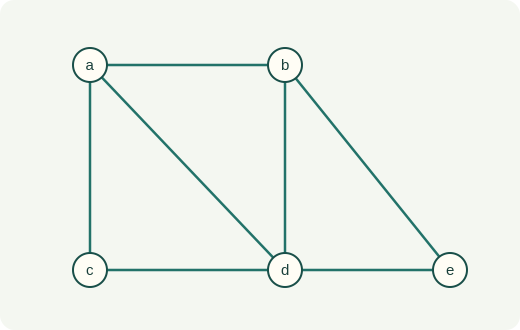
The traversed edges are ac, cd, de, eb, bd, da and ab. These are exactly the seven displayed edges, without repetition. It is an open Euler trail from a to b. It is not an ordinary path because a, b and d recur.
Count before tracing
An Euler circuit traverses a graph with 12 edges. How many edge traversals and how many entries in its vertex sequence occur?
Hint
A sequence with k traversed edges has k + 1 vertex entries.
Show worked solution
There are 12 traversals and 13 vertex entries, with the first and last equal. The number of different vertices can be much smaller.
Euler’s degree criterion
Undirected Euler criterion
After isolated vertices are ignored, all vertices with edges must belong to one connected component. An Euler circuit exists exactly when every vertex has even degree. An open Euler trail exists exactly when there are two odd-degree vertices; these must be its endpoints. More than two odd vertices prevents any Euler trail.
At an intermediate visit you enter on one edge and leave on another, pairing incident ends. Only the start and finish of an open route can have an unpaired end. This proves the necessity of the parity rule. To build a circuit when degrees are even, follow unused edges until returning, then splice in unused closed routes at visited vertices.
Apply the criterion to the seven bridges
Show worked solution
The network is connected but has four odd vertices. It has neither an Euler circuit nor an open Euler trail. Changing how the map is drawn does not change those degrees.
Find the mistake: parity alone
Two separate triangles have all degrees even. A learner concludes that the whole graph has an Euler circuit. Repair the argument.
Hint
Can one route travel between components?
Show worked solution
No. There are two edge-containing components and no joining edge. Each triangle has its own Euler circuit, but no single route covers both. Connectedness of the edge-containing part is required.
Königsberg bridges and graph
Constructing and repairing Euler routes
A degree test proves existence but does not supply the order of edges. Keep a list of unused edges and cross each off as it is used. If you close a route while unused edges remain at a visited vertex, build another closed route there and insert it into the first.
A new bridge changes parity
Show worked solution
Both odd degrees become even and the graph stays connected. The new graph has an Euler circuit. One circuit is a–c–d–e–b–d–a–b–a, where the last two ab traversals use the two different parallel edges. Edge identities matter.
Repair four odd vertices
A connected multigraph has four odd vertices. What is the fewest added edges needed to make all degrees even if you may join any pair of vertices?
Hint
Each added edge can change the parity of at most two vertices.
Show worked solution
At least two edges are needed. Pair the four odd vertices and add an edge between each pair. Two edges suffice; loops do not help because they add two to one degree without changing its parity.
Doorways and rooms
For a gallery walk, rooms become vertices and doorways edges. Different doorways between the same rooms remain parallel edges. If the task includes an outside entrance, model the outside explicitly rather than silently changing the network.
A gallery route
Show worked solution
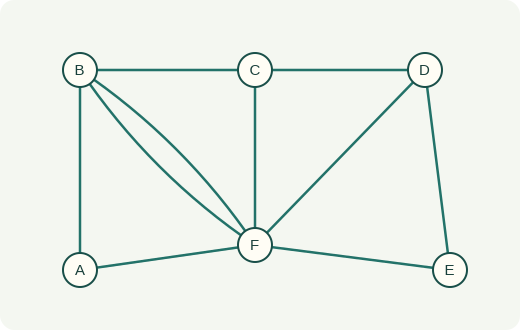
Degrees are A:2, B:4, C:3, D:3, E:2, F:6. The graph is connected and only C and D are odd. An open Euler trail exists, beginning in C and ending in D, or the reverse. Returning to the original room while using every doorway exactly once is impossible.
One route is C–B–A–F–B–F–C–D–E–F–D. The two B–F traversals use different doorways.
One additional doorway
Where could a new doorway be placed to allow a circuit?
Hint
Join the two odd rooms.
Show worked solution
Join C to D with another doorway. Both degrees become even, and an Euler circuit then exists. A doorway between two even rooms instead creates two new odd vertices.
Every vertex exactly once
Hamilton path and cycle
A Hamilton path visits every vertex exactly once. A Hamilton cycle visits every vertex once and returns to its start. “Hamilton circuit” is another common name for Hamilton cycle. Unused edges are allowed. We use the simple-graph cycle convention: at least three distinct vertices.
| Requirement | Euler | Hamilton |
|---|---|---|
| Must cover | Every edge | Every vertex |
| May repeat vertices? | Yes | Only shared start/end in a cycle |
| May skip edges? | No | Yes |
| General degree test? | Exact parity criterion for undirected graphs | No equivalent all-purpose odd/even test |
Airline itinerary
Show worked solution
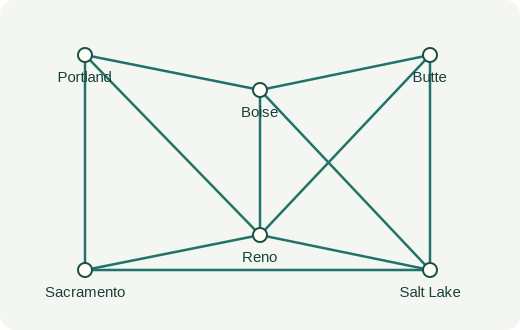
One Hamilton cycle is Portland–Boise–Butte–Salt Lake City–Reno–Sacramento–Portland. Check each consecutive pair against the available edges and count each city once before returning. This does not claim the itinerary is shortest.
Hamilton but not Euler
For K₄, determine whether there is a Hamilton cycle and an Euler circuit.
Hint
Compare vertex visitation with the parity of degree three.
Show worked solution
A–B–C–D–A is a Hamilton cycle in K₄. Each vertex has odd degree three, so four odd vertices prevent an Euler trail. A Hamilton cycle uses four of the six edges.
Ruling out Hamilton cycles
A vertex on a Hamilton cycle needs two distinct incident cycle edges. Therefore a pendant vertex prevents a Hamilton cycle. A bridge also prevents a Hamilton cycle spanning both sides: crossing to the other side and returning would reuse the only connection. An articulation vertex separating the graph likewise obstructs such a cycle.
Euler does not imply Hamilton
Show worked solution
O has degree four and the other vertices degree two; the connected graph is Eulerian. A Hamilton cycle cannot visit vertices in both triangles without using O more than once before closing. The shared vertex is an articulation vertex.
Endpoints in a tree
Can a tree with four pendant vertices have a Hamilton path? Compare a simple chain.
Hint
A pendant vertex on a spanning path must be an endpoint.
Show worked solution
No: four pendant vertices would require four endpoints, but a path has only two. A simple chain itself is a Hamilton path, though a nontrivial tree has no Hamilton cycle.
Weights and shortest paths
A weighted route
Edge weights can represent distance, time or cost. Add the weights of traversed edges to obtain route weight. Use one consistent unit. Geometric lengths in the drawing do not replace the numerical weights.
With nonnegative weights, Dijkstra’s method permanently labels the unvisited vertex having the smallest tentative distance. Update its neighbors by comparing the current estimate with the distance through that vertex. A directed edge may be followed only in its arrow direction.
Shortest route from S to T
Show worked solution
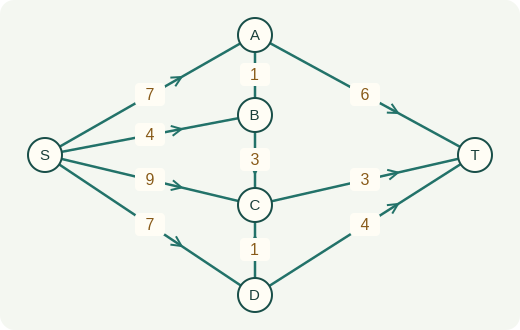
| Settled vertex | Final distance from S | Important update |
|---|---|---|
| S | 0 | A 7, B 4, C 9, D 7 |
| B | 4 | A becomes 5; C becomes 7 |
| A | 5 | T becomes 11 |
| C and D | 7 | C gives T = 10; D gives 11 |
| T | 10 | Final |
The shortest route is S–B–C–T, weight 4 + 3 + 3 = 10. The direct-looking S–A–T route weighs 13. This is a shortest path, not a Hamilton tour.
A local choice can fail
In the displayed network, would choosing the smallest outgoing edge at every step necessarily find the shortest path?
Hint
A locally smallest edge does not compare complete remaining costs.
Show worked solution
No general guarantee exists. Dijkstra compares total tentative distances from S, not merely the next edge. For example an edge of weight 1 can lead to a required edge of weight 100, while another first edge of weight 2 can lead to weight 2.
Shortest Hamilton tours
A shortest Hamilton tour must visit every vertex and return while minimizing total weight. This is different from finding a shortest route between two endpoints. For a small complete undirected graph, list tours systematically: fix one starting vertex and treat reversals as the same tour.
\[\text{Distinct tours in }K_n=\frac{(n-1)!}{2}\quad(n\ge3)\]Check the best complete tour
Show worked solution
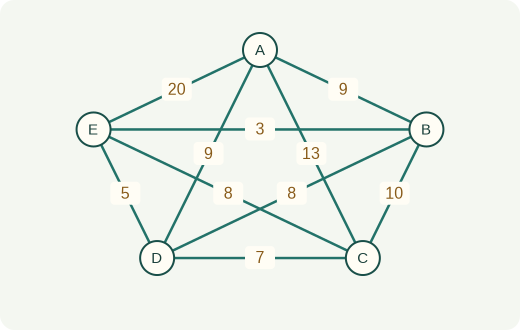
Fix A. There are 4!/2 = 12 tours after reversals are identified. Comparing only a handful of plausible routes is not enough to prove a minimum.
Exhaustive comparison gives A–B–E–C–D–A, total 36. The reverse tour has the same cost.
| Tour from A (reversal omitted) | Weight |
|---|---|
| A–B–E–C–D–A | 36 |
| A–B–E–D–C–A | 37 |
| A–C–B–E–D–A | 40 |
| A–B–C–E–D–A | 41 |
| A–C–E–B–D–A | 41 |
| A–B–D–E–C–A | 43 |
| A–D–C–B–E–A | 49 |
| A–B–C–D–E–A | 51 |
| A–C–D–B–E–A | 51 |
| A–B–D–C–E–A | 52 |
| A–D–B–C–E–A | 55 |
| A–C–B–D–E–A | 56 |
All twelve cases have been checked, so the minimum is established. Nearest-neighbor routes may be useful candidates, but their cost alone does not certify optimality.
A bound before enumerating
For each vertex in a weighted complete graph, sum its two least incident weights. Why does half the total give a lower bound for any Hamilton tour?
Hint
Each tour uses two incident edges per vertex, and every tour edge is counted at both ends.
Show worked solution
At each vertex, a tour’s two incident weights sum to at least the two least available. Adding these local bounds counts each tour edge twice. Dividing by two yields a lower bound. A tour attaining the bound is optimal; otherwise the bound alone does not identify the optimum.
Explore and compare route requirements
Use the network explorer to change an edge and predict how the Euler classification changes. Then consider the Hamilton question separately. A successful Euler route is not evidence of a Hamilton cycle.
Choose the right model
A worker must inspect every road; a courier must visit every office; a traveler wants the cheapest connection from S to T. Which problem does each describe?
Hint
Identify the object that must be covered and whether returning is required.
Show worked solution
Road inspection is an Euler-style edge-coverage task (or a repeated-edge optimization if exact coverage is impossible). Office visitation is Hamilton-style, with a cycle only if returning is required. The last task is a weighted shortest-path problem. None can be substituted for another merely because all use graphs.
Interactive exploration
References
R. N. Aufmann, J. S. Lockwood, R. D. Nation and D. K. Clegg, Mathematical Excursions, 3rd ed., graph theory chapters. Further reading: OpenStax, Contemporary Mathematics, Graph Theory. Figures are redrawn for this lesson; vertex positions are schematic.