Credit Cards and APR
Read a billing cycle, build an average daily balance, and distinguish card interest, installment APR and effective yield.
Credit, limits and statements
A credit card provides revolving credit: purchases use part of a limit, and repayments restore available credit subject to the agreement. A credit limit is permission to borrow up to a stated amount; it is not income. A statement summarizes posted activity for one billing cycle.
Read these separately
The statement balance is the amount shown when a cycle closes. The minimum payment is the smallest required payment for that bill. The payment due date is a deadline, not the date the purchases occurred. A finance charge is a cost of borrowing; fees may be separate.
Available credit
Show worked solution
Available credit = 20,000 − 6,500 = ₱13,500. A later ₱2,000 payment would reduce the balance to ₱4,500 and restore available credit to ₱15,500 when posted.
Minimum is not full payment
A bill shows ₱8,400 statement balance and ₱420 minimum payment. If ₱420 is paid, how much of the original balance remains before new interest or transactions?
Hint
Subtract the payment from the balance; a minimum does not erase the balance.
Show worked solution
₱8,400 − ₱420 = ₱7,980 remains. Meeting a minimum payment does not by itself preserve an interest-free grace period.
Statement dates and payment dates
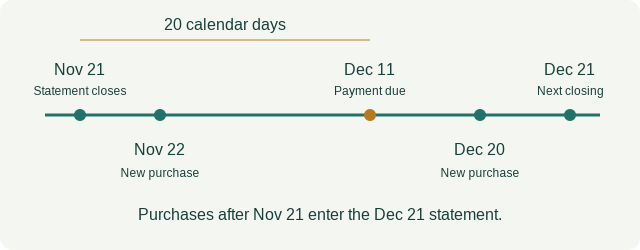
Draw a timeline before counting days. For the exercises in this section, statements close on the same numbered day each month, purchases after closing enter the next statement, and payment is due exactly 20 calendar days after closing. These are stated classroom assumptions, not universal card rules.
November and December purchases
Show worked solution
November has 30 days. November 22–30 supplies 9 days and December 1–11 supplies 11, giving 20 days. Payment is due December 11. Both purchases occur after November 21 but before December 21, so they appear on December 21.
Three statement checks
A card closes every 23rd: which statement includes a January 19 purchase? Which statement includes a March 15 purchase if the closing day is the 14th? When is payment due for a July 14 statement under the 20-day rule?
Hint
Locate purchases relative to closing, then count calendar days for the due date.
Show worked solution
January 23; April 14; August 3. July 15–31 contributes 17 days, followed by August 1–3. Transactions on the closing date need a stated posting/cutoff rule.
Finance charges and grace periods
Many agreements provide a grace period for qualifying purchases if required balances are paid in full on time. Cash advances, carried balances and fees may follow different rules. Always distinguish the assumptions of a mathematical exercise from the terms of an actual card.
Two periodic models
For a stated monthly periodic rate \(m\), use \(FC=ADB\times m\). For a stated daily simple-interest model using APR \(a\) and a 365-day basis over \(D\) days, use \(FC=ADB\times(a/365)D\). Do not substitute one model for the other without being told.
APR is an annual borrowing rate. APY or effective annual yield reflects annual compounding. They are not interchangeable names. An 18% nominal annual rate has a 1.5% monthly periodic rate in a model that divides APR by twelve.
Choose the rate
An ADB is ₱10,000. Compare one cycle using 1.5% monthly with a 30-day cycle using 18% APR/365, with simple daily accrual.
Hint
The first is one monthly rate; the second multiplies a daily rate by 30.
Show worked solution
Monthly model: ₱150. Daily simple model: 10,000(0.18/365)(30) ≈ ₱147.95. The difference follows from the specified convention, not a rounding error.
Average daily balance
Weight balances by time
If balance \(B_i\) lasts \(d_i\) days, \(ADB=\frac{\sum B_i d_i}{\sum d_i}\). The denominator is all days in the cycle, including days with zero balance. Each day is counted exactly once.
An ordinary average of the distinct balances gives each balance equal influence. ADB instead gives each day equal influence: a balance lasting ten days matters twice as much as one lasting five days.
Miguel’s balances
Show worked solution
| Daily balance | Days | Balance × days |
|---|---|---|
| 15,240.75 | 6 | 91,444.50 |
| 8,920.20 | 4 | 35,680.80 |
| 12,310.50 | 10 | 123,105.00 |
| 3,405.10 | 5 | 17,025.50 |
| Total | 25 | 267,255.80 |
FC = 10,690.232(0.015) = ₱160.35 to the nearest cent. Round the final charge rather than each weighted balance.
Zero-balance days count
A 30-day cycle has zero balance for 20 days and ₱3,000 for ten days. Find ADB and the finance charge at 2% monthly.
Hint
Include all thirty days in the denominator.
Show worked solution
ADB = (0 × 20 + 3,000 × 10)/30 = ₱1,000. FC = ₱20. Ignoring zero days would incorrectly triple the charge.
Building a transaction ledger
List posting dates in order. A purchase adds to the balance; a payment subtracts. After each posting, hold that new balance until the next posting. In these examples a cycle starts on the first stated date and ends the day before the next statement; a transaction changes its posting day’s balance.
April 10 to May 10
Show worked solution
| Dates (inclusive) | Activity at start | Balance | Days | Product |
|---|---|---|---|---|
| Apr 10–11 | Opening | $315 | 2 | 630 |
| Apr 12–14 | +$28 | $343 | 3 | 1029 |
| Apr 15–23 | −$50 | $293 | 9 | 2637 |
| Apr 24–May 9 | +$123 | $416 | 16 | 6656 |
The ending balance $416 is not the average balance. Check that 2 + 3 + 9 + 16 = 30 before computing the charge.
March 10 to April 10
Opening debt is $620 on March 10. Purchases of $214 and $67 post March 15 and March 30; a $200 payment posts March 22. Find the April 10 charge at 1.5% monthly.
Hint
The cycle contains 31 days. Split at every transaction.
Show worked solution
| Cycle days | Balance | Days | Balance × days |
|---|---|---|---|
| 1–5 | 620.00 | 5 | 3,100.00 |
| 6–12 | 834.00 | 7 | 5,838.00 |
| 13–20 | 634.00 | 8 | 5,072.00 |
| 21–31 | 701.00 | 11 | 7,711.00 |
Finance charge = ADB × 1.5% = 10.51. The transaction takes effect at the start of its posting day; the next statement date is excluded from the cycle.
Marichu’s March activity
Marichu starts March 1 at zero. Purchases of ₱3,500 and ₱10,700 post March 7 and 19, and a ₱10,000 cash advance posts March 21. Use March 1–30 (the March 31 closing date is excluded), 2.5% monthly for every transaction, and no grace period or fees. Find the charge.
Hint
The four spans are 6, 12, 2 and 10 days. These explicit assumptions are needed because cash advances can use different real-world rules.
Show worked solution
| Cycle days | Balance | Days | Balance × days |
|---|---|---|---|
| 1–6 | 0.00 | 6 | 0.00 |
| 7–18 | 3,500.00 | 12 | 42,000.00 |
| 19–20 | 14,200.00 | 2 | 28,400.00 |
| 21–30 | 24,200.00 | 10 | 242,000.00 |
Finance charge = ADB × 2.5% = 260.33. The transaction takes effect at the start of its posting day; the next statement date is excluded from the cycle.
July 1 to August 1
Opening debt is ₱10,240. Purchases post July 7 for ₱3,150 and July 22 for ₱810; a ₱4,000 payment posts July 15. Find the charge at 1.2% monthly.
Hint
July has 31 days. Use updated balances, not separate interest on purchases alone.
Show worked solution
| Cycle days | Balance | Days | Balance × days |
|---|---|---|---|
| 1–6 | 10,240.00 | 6 | 61,440.00 |
| 7–14 | 13,390.00 | 8 | 107,120.00 |
| 15–21 | 9,390.00 | 7 | 65,730.00 |
| 22–31 | 10,200.00 | 10 | 102,000.00 |
Finance charge = ADB × 1.2% = 130.18. The transaction takes effect at the start of its posting day; the next statement date is excluded from the cycle.
Why payment timing matters
When interest is based on daily balances, the same payment generally reduces the charge more if it posts earlier. Compare two schedules with the same final balance to see why an ending balance alone cannot determine interest.
Same ending debt, different average
Show worked solution
Early payment: 5 days at ₱10,000 and 25 at ₱6,000, so ADB = ₱6,666.67 and FC = ₱100. Late payment: 20 days at ₱10,000 and 10 at ₱6,000, so ADB = ₱8,666.67 and FC = ₱130. Both end at ₱6,000; the earlier payment saves ₱30.
Find the mistake: equal weighting
A student averages balances of ₱8,000 (5 days) and ₱2,000 (25 days) and reports ADB = ₱5,000. Repair the reasoning.
Hint
The balance list has two entries, but the cycle has thirty daily observations.
Show worked solution
The longer low-balance span must receive more weight. The correct ADB is ₱3,000.
Explore daily balances
Installment loans and approximate APR
An add-on loan computes its stated simple-interest finance charge on the original amount even while the borrower repays principal through installments. The borrower has use of a declining unpaid balance, so this quoted add-on rate understates the comparable borrowing rate.
Classroom approximation
For \(N\) equal monthly payments over \(T=N/12\) years and annual add-on simple rate \(r\), \(APR\approx2Nr/(N+1)\). Equivalently \(APR\approx24F/[P(N+1)]\) when \(F=PrT\). This is an approximation, not an exact regulatory disclosure or an APY.
A refrigerator on installments
Show worked solution
Down payment = $135, amount financed P = $540. One-year finance charge F = 540(0.09) = $48.60. Total installments = $588.60; monthly payment = $49.05.
\[APR\approx\frac{2(12)(0.09)}{13}=0.1661538\ldots\]Approximate APR is 16.62%. It exceeds 9% because principal is returned throughout the year.
Three months versus six months
Estimate APR for Chuong’s $2,500 loan at 9% annual add-on interest repaid in three monthly payments, and Charles’s $4,000 loan at 8% repaid in six monthly payments.
Hint
Apply the annual-rate formula with N = 3 and N = 6; the principal cancels.
Show worked solution
Chuong: 2(3)(0.09)/4 = 13.5%. Charles: 2(6)(0.08)/7 ≈ 13.7% to the nearest tenth of a percent. Using 9% × 3 as the finance-charge fraction would confuse months with years.
Down payments and monthly payments
Kelly buys a $2,400 computer with 15% down, then finances the rest for 24 months at 10% annual add-on simple interest. Jill buys a $1,500 stereo with 20% down and 12 monthly payments at 7%. Find financed principal, monthly payment and approximate APR.
Hint
Subtract the down payment; use N/12 years in F = PrT.
Show worked solution
Kelly: P = $2,040; F = $408; payment = $102; APR ≈ 2(24)(0.10)/25 = 19.2%. Jill: P = $1,200; F = $84; payment = $107; APR ≈ 2(12)(0.07)/13 = 12.9% to the nearest tenth.
Reading and auditing a bill
An accurate calculation needs more than a rate: check the cycle endpoints, posted transactions, balance category, rate basis and applicable fees. The examples here use simplified stated models so every calculation can be reproduced.
Audit the days
A learner uses April 10–12, April 12–15, April 15–24 and April 24–May 10, including both endpoints in every span. Why is this wrong?
Hint
Check how often each transaction date and the closing date are counted.
Show worked solution
April 12, 15 and 24 are counted twice, and May 10 belongs to the next cycle under this model. Use Apr 10–11, Apr 12–14, Apr 15–23 and Apr 24–May 9. Their lengths sum to 30.
Reverse a finance charge
A 30-day cycle has ₱5,000 for ten days and an unknown balance B for twenty days. At 2% monthly, the charge is ₱80. Find B.
Hint
First recover ADB from the charge, then reverse the weighted average.
Show worked solution
20B = 70,000, so B = ₱3,500. Substitute back to verify the charge.
References
R. N. Aufmann et al., Mathematical Excursions, 3rd ed.; R. L. Brown and S. Kopp, Mathematics of Finance, 8th ed. Further reading: OpenStax, Contemporary Mathematics, Money Management; Consumer Financial Protection Bureau, credit-card interest calculations and grace periods. These are mathematical models; actual agreements specify rates, fees, posting rules and grace-period eligibility.